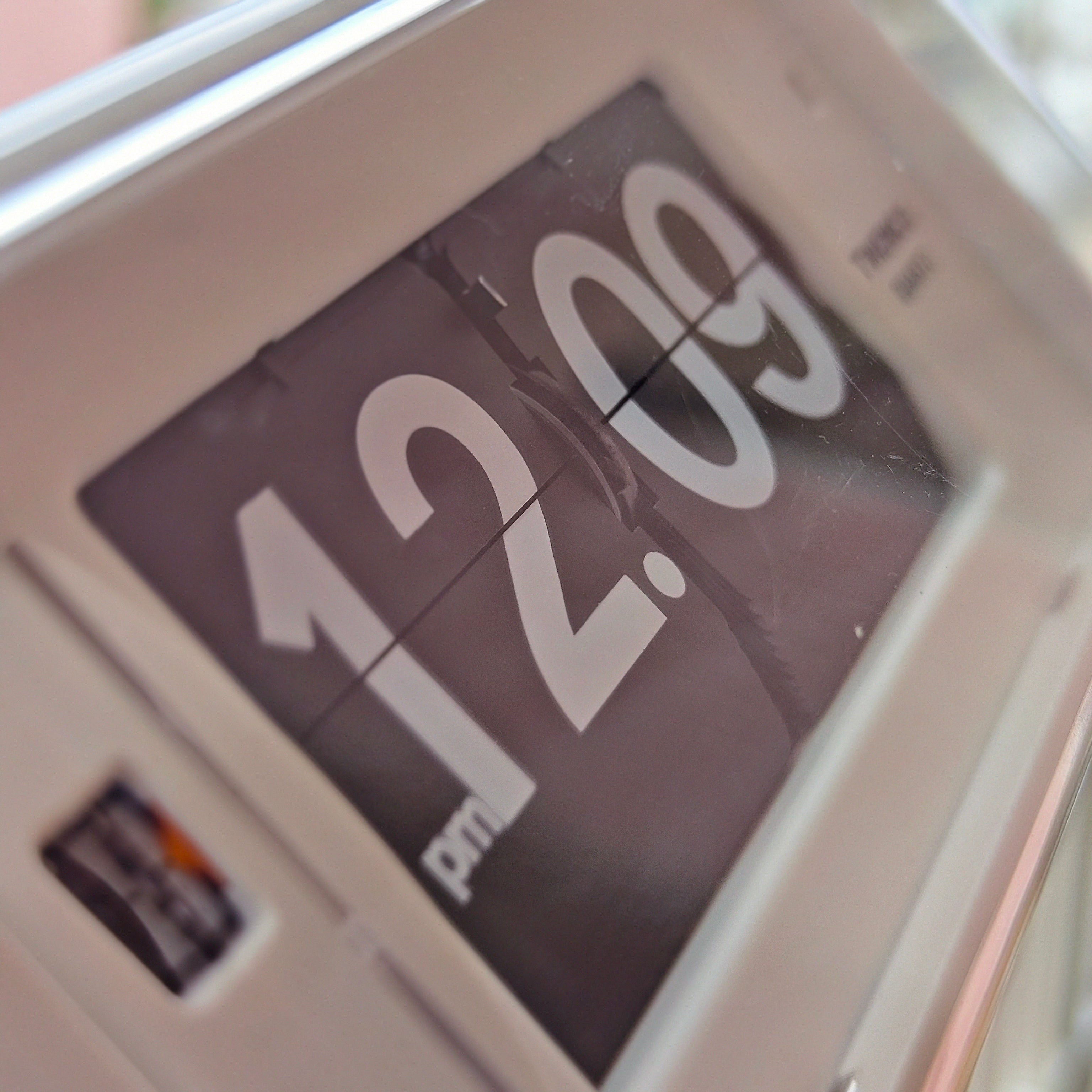
Yes—most modern flip clocks are designed to run continuously. A clock cannot keep useful time if it is regularly switched off, and current battery-powered models are normally intended to remain operating day and night. The important exceptions are clocks that will be stored for a long period, vintage clocks with unknown condition, and any clock showing signs of strain, heat, unusual noise or erratic movement.
Leaving a flip clock running does use battery power and puts normal operating cycles on the mechanism, but that is not the same as damaging it. For a healthy modern clock, steady use is the expected use case. Good ownership is less about switching it off every evening and more about using the specified power source, keeping the clock level and clean, and responding early when its behaviour changes.
Why continuous operation is normal
A flip clock advances time through repeated, controlled movements. In a mechanical display, a motor and gear train release the hour and minute cards at the correct intervals. Stopping the clock stops both the timekeeping and the display sequence; when restarted, it has to be set again.
Manufacturer-stated battery runtimes also assume ordinary continuous use. For example, the NeXtime Metal Big Flip clock is specified for two D batteries and lists an operating period of about two years, while the TWEMCO QT-30 is specified for one C-size alkaline battery with an operating period of about three years. These figures are model-specific estimates rather than guarantees, but they illustrate that long, uninterrupted operation is part of the design brief.
If you own a different model, use its manual rather than copying another clock’s battery type or maintenance routine. NeXtime, for example, keeps a dedicated page of product manuals, including one for its Big Flip models.
Does running all the time wear out the mechanism?
Any moving mechanism accumulates wear while it operates. Flip cards cycle, gears turn and bearings carry load. Continuous use therefore contributes to normal wear, but regularly turning a healthy clock off is not usually necessary or particularly useful. A clock is a working object, and its movement is intended to perform those cycles.
What matters more is the condition in which those cycles occur. Dust, contamination, misalignment, excess friction, incorrect lubrication, a weak power supply or a distorted card can make the mechanism work harder. Heat and humidity can also affect cases, contacts and older materials. The practical goal is smooth operation, not an artificially low number of flips.
For a fuller view of components, age and usage, see our guide to how long flip clocks last. If a clock begins skipping, sticking or making a new grinding sound, use the least invasive checks in our guide to common flip-clock problems rather than repeatedly switching it on and off.
What continuous use means for battery life
A battery clock draws power while it keeps time and advances the display. Leaving it running will eventually exhaust the battery; switching it off during a long absence can preserve some capacity. In normal daily ownership, however, frequent shutdowns trade a small amount of saved energy for repeated resetting and a clock that is not doing its job.
Battery life varies with the movement, card size and weight, battery chemistry and quality, temperature, friction, and the number of functions being powered. A large calendar display may behave differently from a compact time-only model. Our article on flip-clock battery consumption explains those variables in more detail.
Follow the device instructions and replace an exhausted battery promptly. Energizer’s battery care guidance recommends using the specified size and type, observing polarity, keeping contacts clean, removing exhausted cells, and not mixing old and new batteries or different types. These habits matter more than a nightly on-off routine.
When should you stop a flip clock?
During long-term storage or an extended period of non-use
If the clock will sit unused for weeks or months, stop it and remove the battery. This reduces needless discharge and lowers the risk that an exhausted or deteriorating cell will leak inside the compartment. Energizer likewise advises switching off a device and removing its batteries when it is not expected to be used for an extended period.
Store the clock in a dry, stable environment away from high heat, direct sun, heavy dust and vibration. Keep the battery separate, and do not leave loose cells where their terminals can touch metal objects.
When the movement sounds or behaves differently
Stop the clock if cards repeatedly jam, the motor strains, a grinding or scraping sound appears, the case or power supply becomes unusually warm, or the clock develops a burning smell. Removing power prevents a struggling component from continuing to load the mechanism. Do not force the cards by hand and do not add household oil through the case.
If the only symptom is that the display flips early or late, the fault may be setting, power, alignment or card timing rather than a reason to retire the clock. Work through our focused guide to a flip clock showing the wrong time.
When the clock is vintage, rare or electrically uncertain
A vintage mains-powered clock deserves a more cautious answer than a current battery model. Old insulation, wiring, motors, lubricants and plastics may have deteriorated even if the clock appears complete. If its service history is unknown, have it assessed by a qualified repairer before leaving it energised unattended.
The Canadian Conservation Institute’s guidance on basic care for clocks and watches recommends a full mechanical assessment before returning an old clock to operation and warns against disassembly without the right experience, tools and workspace. For a rare or historically important clock, preservation may take priority over continuous running.
A sensible everyday routine
- Leave a healthy modern clock running. Continuous timekeeping is its normal job.
- Use the exact power source in the manual. Do not substitute battery types or an unapproved adapter.
- Keep it stable. Place a table clock on a level surface or mount a wall clock securely so the mechanism and cards are correctly aligned.
- Keep the exterior clean and dry. Remove surface dust gently and keep moisture away from openings and contacts.
- Watch for changes. New noise, repeated jams, heat, smell or sharply worse timekeeping deserves attention.
- Remove batteries for long storage. Do this before packing the clock away or leaving it unused for an extended period.
- Escalate vintage repairs. Unknown mains wiring and delicate old mechanisms are not good candidates for casual DIY work.
If you are comparing current models for regular use, the TWEMCO flip clock collection includes both compact table clocks and larger calendar displays. Always check the individual product page for its power source, operating format and placement requirements.
Frequently Asked Questions
Should I turn my flip clock off at night?
Usually not. A healthy modern flip clock is intended to keep time continuously. Turn it off at night only if its sound disturbs you, the manufacturer instructs you to do so, or it shows a fault such as straining, heat or repeated jams.
Will leaving a flip clock on drain the battery quickly?
It will use battery power continuously, but many purpose-built battery flip clocks are designed for long operating intervals. Actual runtime depends on the model, battery, temperature and mechanical condition, so use the manufacturer’s estimate as a guide rather than a promise.
Should I remove the battery when I go on holiday?
For a short trip, it is generally reasonable to leave a healthy clock running. For an extended absence or long storage, switch it off and remove the battery to avoid needless discharge and reduce leakage risk.
Is it safe to leave a vintage electric flip clock running unattended?
Not automatically. If the wiring, motor condition or service history is unknown, have the clock inspected by a qualified professional before continuous or unattended use. Stop using it immediately if it becomes hot, smells unusual or behaves erratically.