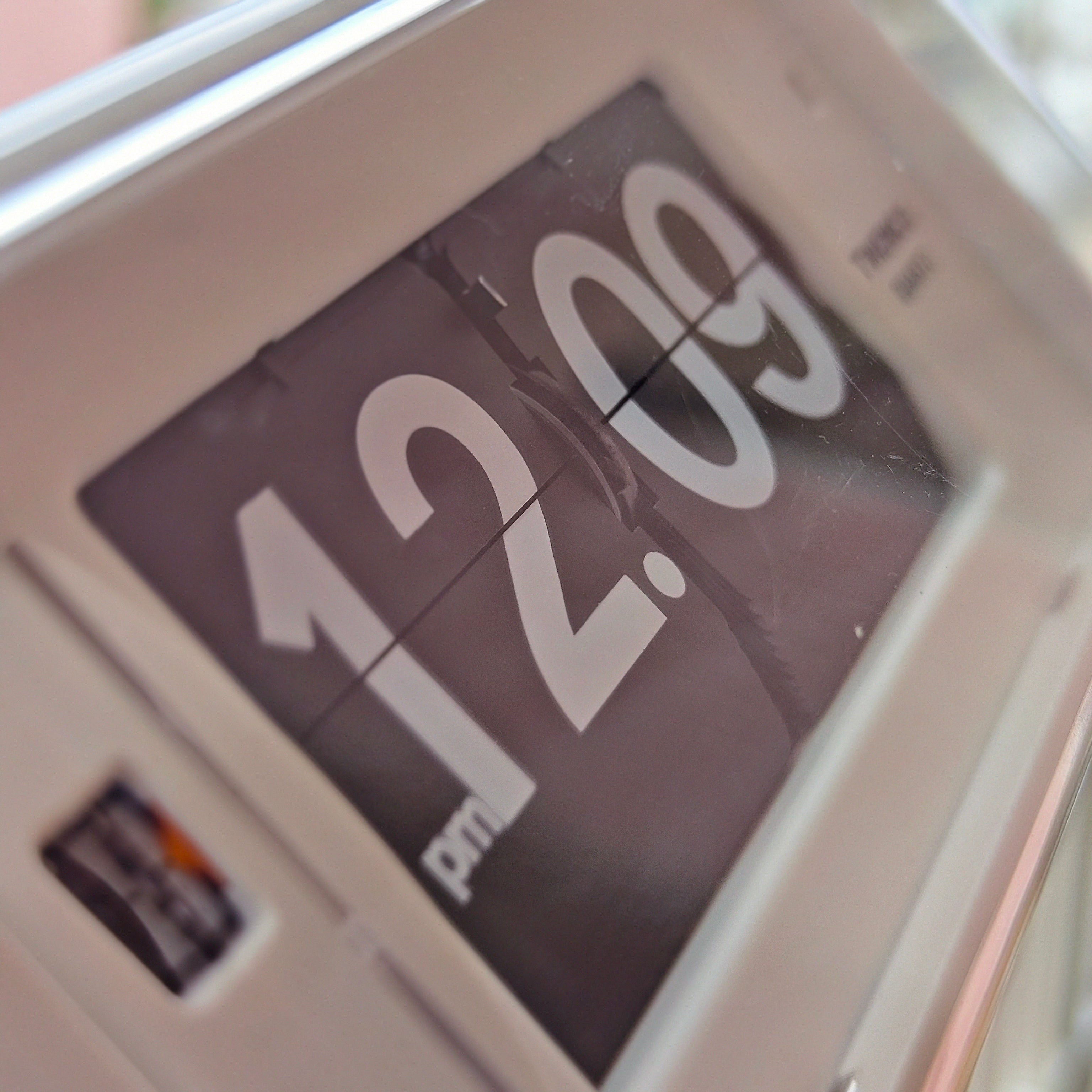
A flip clock is a strong everyday choice if you prefer reading the hour and minute directly as large numbers and enjoy the small physical change of the display. A traditional analog clock is often the better fit if you like judging time by the position of hands, want a broad choice of wall designs, or need a quiet sweep movement. Neither format wins every room.
The useful question is how you actually check the time: from a desk, across a living room, while getting ready, or in a dark bedroom. This comparison looks at real moving-card flip clocks and conventional clocks with hands, focusing on readability, sound, maintenance and design.
Flip clock vs analog clock at a glance
| Everyday consideration | Physical flip clock | Traditional analog clock |
|---|---|---|
| Reading the time | Hour and minute appear as numerals | Hands show the time on a dial |
| Seeing time remaining | Usually requires comparing numbers | Hand positions offer a visual reference for intervals |
| Sound | Card changes can make an audible click | Depends on the movement: ticking, sweep or other sounds |
| Darkness | Unlit cards need room light | Unlit hands and dial need room light |
| Routine care | Correct power source, setting controls and protection of cards | Correct power source, setting controls and protection of hands |
| Design effect | Moving typography and a distinctive physical display | Dial, hands, frame and material define the appearance |
| Accuracy | Check the specific timekeeping system and specification | Check the specific timekeeping system and specification |
First, separate the display from the movement
For this comparison, “analog clock” means the familiar dial with hour and minute hands. A flip clock uses physical cards to display numbers. Those labels describe what you see, not a complete account of the technology inside.
Quartz is a timekeeping method. As NIST explains how quartz clocks keep time, a quartz crystal vibrates in an electronic circuit and its frequency is counted to produce timing signals. A physical display can therefore coexist with electronic timekeeping; moving hands or cards do not, by themselves, establish the source of the timing signal.
This matters when shopping. Do not assume that “mechanical flip” means a wound mainspring, that “analog” means battery-free, or that a numeral display must be more accurate. If you are comparing a real flip mechanism with an animated screen instead, our separate guide to mechanical and digital flip clocks covers that decision.
Readability: exact numbers or the shape of time?
When a flip display is easier to use
A clear flip display gives a direct answer such as 8:42. You do not have to identify the minute hand or translate its position into minutes. That can suit a desk, reception counter or shelf where the main task is checking the current time.
It is still worth examining the actual typography. Large numerals, strong contrast and enough space between hour and minute matter more than the category name. A seam through the middle of a digit, glare from a cover or a steep viewing angle can make an otherwise attractive display less useful.
For a simple numerical desk option, the TWEMCO QT-30 table flip clock is one model to assess against your available space. Compare the front-facing display at your normal seated distance rather than relying only on a close-up photograph.
When an analog dial is more useful
If you already read hands comfortably, their positions give a visual picture of the hour. At 8:45, the minute hand occupies the three-quarter position; you can see the remaining quarter of the dial before nine. Some people find that more useful when pacing a routine or watching the approach of an appointment.
This is a preference, not a promise that analog clocks improve productivity. A sparse marker dial may be beautiful but inconvenient for someone still learning to read hands. Choose clear numerals and minute marks when those details help the people who will use the clock.
The Wabi-Sabi wooden wall clock with a number dial offers an example of that visual approach: a circular face, hands and prominent numerals. Judge the contrast as carefully as the frame; a large dial is useful only if its information remains clear.
Across the room and after dark
Test both formats from the position where you will actually look at them. A compact flip clock on a distant shelf can be less readable than a well-designed wall dial; a large flip display can be clearer than a decorative analog clock with fine hands. Neither result follows from format alone.
Ordinary printed cards and an unlit dial both depend on ambient light. If you need to read the clock in darkness, look for an explicitly specified light or luminous feature. Check how it operates, whether it stays on, and whether that suits the room.
Sound: choose the specific clock, not the label
A physical flip clock can make a click or flap sound when its cards change. The important issue is whether you welcome that brief event. On a busy desk it may be a pleasant part of the object; beside a bed, the same sound may become distracting.
Analog clocks vary too. A step movement can produce a regular tick, while a sweep design is a useful starting point for a quieter shortlist. NeXtime’s manufacturer FAQ distinguishes silent and step movements, illustrating why a dial alone tells you little about sound.
For a sound-sensitive desk or bedroom, consider a model specifically sold for quiet operation, such as the Silent Metal Table Clock. Treat the product description as a starting point, then ask about the exact model and listen in a quiet setting if possible. A video recorded in a busy room cannot establish how a clock will sound beside your pillow.
A flip once per minute and a repeated tick are different experiences. There is no useful universal decibel figure for either category, and “quartz” alone is not a silence guarantee.
Maintenance and reliability in everyday ownership
For modern battery-powered examples of either format, routine ownership usually begins with the correct battery and the proper setting procedure. Check the manual for size, chemistry, polarity and any restrictions on turning the controls. NeXtime’s product-manual directory separates general clock instructions from model-specific guidance, including flip clocks.
Follow Energizer’s battery-care guidance: use the battery specified by the device instructions, remove exhausted batteries promptly, and remove batteries for extended periods of non-use. With a multi-battery clock, replace the set together rather than mixing old and new cells.
The practical difference lies in what needs protection. Flip cards need room to move; do not push them to set the time or let nearby objects touch the display. Analog hands also need clearance and should not be bent or forced. Use the designated setting control and follow the manufacturer’s cleaning advice.
A case can help shield a display, while an open design makes its movement part of the appearance. The MIDCLOCK Home Decor Flip Clock is an example of an exposed flip design. That visual appeal should be considered alongside where it will sit and how easily people or objects could reach it.
Do not infer a guaranteed lifespan from the format or number of visible parts. Condition, construction and access to service matter. Our guide to flip-clock lifespan and maintenance explores those ownership questions in more detail. Vintage mains-powered clocks require a different assessment from a new battery-powered desk clock.
Accuracy: both need a model-specific check
A display that shows exact minute numerals looks precise, but that does not prove its rate is accurate. Similarly, an analog clock with a seconds hand offers more visible detail without necessarily keeping better time.
Compare the maker’s specification, its stated conditions and the timekeeping system. If you are evaluating a clock you already own, set it against a reliable reference and observe whether the difference stays fixed or grows over several days. A setup error and ongoing drift call for different responses.
For physical flip displays, also distinguish the clock’s rate from the moment the card changes. Our guide to flip-clock accuracy and drift explains that distinction. For ordinary household use, choose a model whose performance meets your needs rather than assuming one display format guarantees better timekeeping.
Design, placement and value
Flip clocks bring moving numerals into a room. They suit a shelf or desk where you want the clock itself to be noticed, particularly when the card proportions and case work with the surrounding books, furniture or equipment. An analog clock offers a different composition: a dial, hands and frame that can blend into the wall or become a decorative focal point.
Start with the intended placement before choosing the style. Measure the usable shelf depth, check mounting requirements and keep the display clear of plants or objects. On a shared wall, think about all the main sightlines rather than just the nearest chair.
Price should buy benefits you can identify: suitable scale, a legible display, the sound you want, dependable controls or a material you enjoy. A premium flip clock is not automatically a better household tool than a straightforward dial. Equally, visible card movement may be exactly the feature that makes a flip worth choosing.
If you have decided on a physical flip display, the TWEMCO flip-clock collection lets you compare different layouts. For a workspace decision, our guide to clocks for a study desk considers placement and distraction alongside appearance.
Which should you choose?
- Choose a flip clock if direct numerical reading and physical display movement are the main attractions, and you are comfortable with its sound and care requirements.
- Choose an analog clock if you prefer hand positions, want a dial to complement the room, or have found a quiet movement that suits your routine.
- For a bedroom, settle sound and night-time visibility first. Neither format automatically answers both needs.
- For a shared room, prioritise the people who must read it, the viewing distance and the clarity of the actual display.
The best everyday clock is the one you can read comfortably, place correctly and enjoy living with. Use the format to narrow the choice, then make the decision on the specific model.
Frequently Asked Questions
Is a flip clock analog or digital?
A physical flip clock displays discrete numerals, so it is often described as a digital display even though cards move mechanically. Here, “analog clock” refers to hands on a dial. Neither description, by itself, identifies the timekeeping system.
Are flip clocks more accurate than analog clocks?
Not automatically. Accuracy depends on the particular movement or time base, its specification and operating conditions. Compare models rather than choosing on the basis of numerals versus hands.
Which format is better for a quiet bedroom?
A specifically quiet analog model is often a sensible starting point if card clicks bother you. Check the exact movement and listen where possible. Also check how you will read the clock after the lights are off.
Do flip clocks need more maintenance?
They have moving cards that need protection and clearance, but there is no universal maintenance schedule for the category. Both formats need appropriate power, correct setting and care according to the model’s instructions.