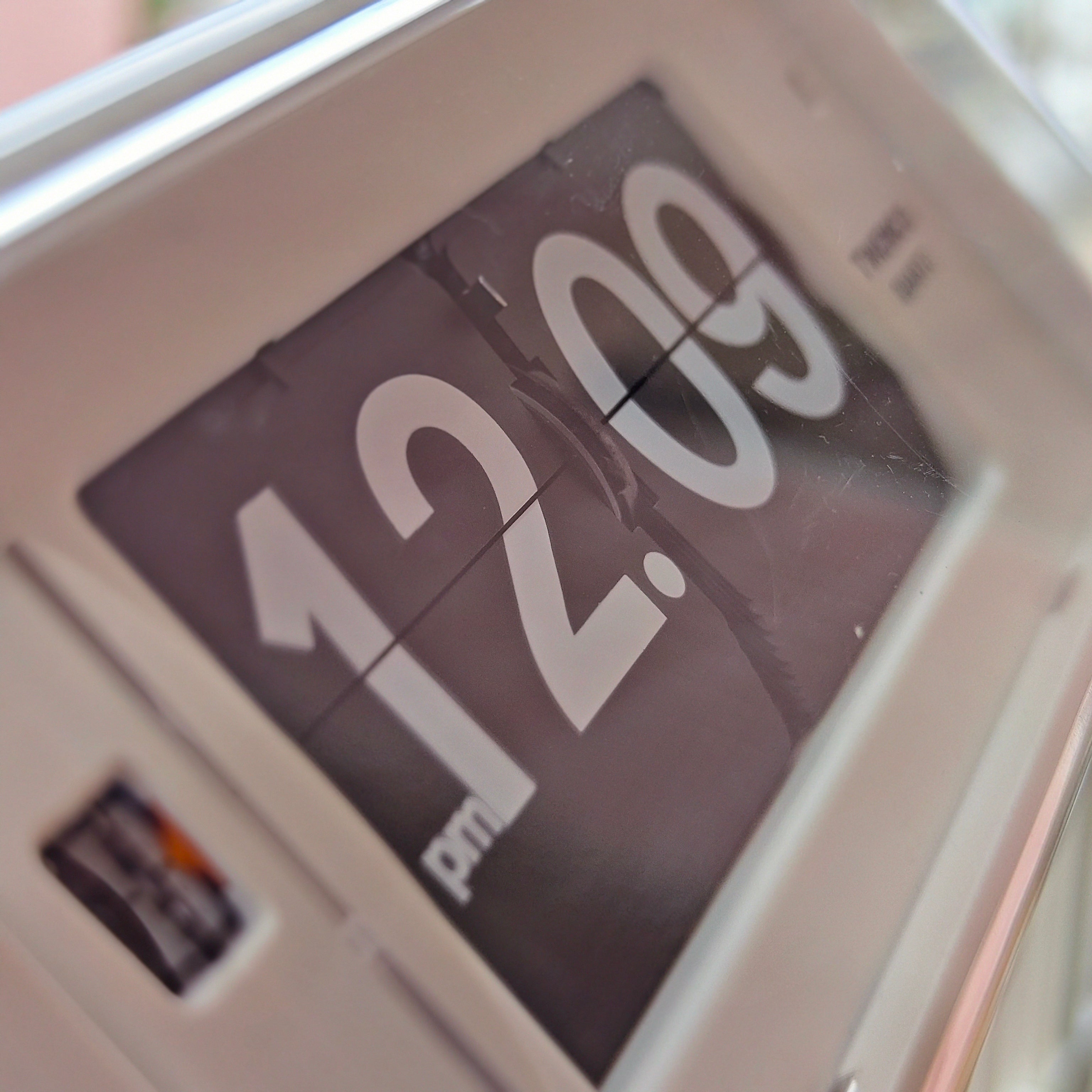
For an everyday desk or wall clock, start by considering a budget of roughly US$50–150. Spend less when you mainly need a clear, simple time display. Move above that range when you can identify a useful improvement: larger readable information, a physical flip mechanism you particularly enjoy, a calendar display, a better-fitting case or support that matters to you.
There is no price at which a clock automatically becomes “good”. A modest clock can suit a kitchen perfectly, while an expensive statement piece can be wrong for a bedroom. The practical question is what the extra money changes in your room and daily routine.
Practical clock price tiers
These are planning bands in US dollars, not industry quality grades or market averages. The examples use Time Will Flip’s current product prices checked on 14 October 2026. Variant prices, availability, shipping and taxes can change.
| Budget | A useful buying focus | What to examine |
|---|---|---|
| Below US$50 | A straightforward time display | Legibility, sound, basic construction and controls |
| US$50–149 | More choice of presentation and everyday functions | Case design, display format, illumination and placement |
| US$150–349 | A particular model, larger format or more specialised display | Actual specifications, finish, size and seller support |
| US$350 and above | A statement piece, substantial calendar display or individual collectible | Clear reasons for the premium, mounting, condition and service |
The bands overlap in what they offer. Physical flip clocks appear at different prices, and a metal case can be available below US$50. Use the numbers to organise a shortlist, then judge the individual clock.
Below US$50: meet the basic brief first
A lower budget can be sensible for a secondary room, a small workspace or a clock whose job is simply to make the time visible. Begin with a display you can read from the intended position and an operating sound you can tolerate.
The Silent Metal Wall Clock — Thick Frame Series, for example, is currently US$40–47 across variants. Its metal construction shows why “plastic at the entry level, metal at the premium level” is an unreliable shortcut. The material name still does not establish assembly quality or how the clock will sound in your home.
Check the back, mounting method, battery access and setting controls. A low price is good value when those basics work for you; it is less useful if the clock is too small, difficult to read or inconvenient to maintain.
US$50–149: choose the experience you want
This is a useful starting band when appearance and everyday convenience both matter. The Medium Wall & Desk Digital Clock is currently US$52, with an LCD display and listed alarm and backlight functions. The MIDCLOCK Home Decor Flip Clock is US$69–89 across variants and uses an exposed physical flip display.
Those examples offer different experiences rather than a simple ranking. One presents information electronically; the other makes moving cards part of its appearance. Choose according to the location, preferred display and features you will use.
At this level, spending more may buy a case shape, finish or visual presence you prefer. That can be worthwhile, provided the clock still meets your requirements for size, sound, readability and power. Attractive styling cannot compensate for an unsuitable bedside display.
US$150–349: ask what changes between models
A higher budget should lead to a more specific comparison. The TWEMCO QT-30 table flip clock is currently US$153–164, while the TWEMCO BQ-50 retro flip clock is US$301. The BQ-50 has a larger listed case, so scale is a meaningful part of the difference.
The accuracy figures also challenge an easy assumption. The QT-30 listing specifies 1.5 seconds per month between 20°C and 25°C; the BQ-50 specifies 3 seconds per month under the same temperature conditions. Paying more does not automatically buy a tighter timekeeping tolerance.
Compare the exact model’s construction, footprint, display dimensions, power requirements and support. The right premium is one that solves your need, such as a more readable clock across a room or a form that fits the space better.
US$350 and above: define the purpose of the premium
A substantial calendar wall clock, a distinctive design object or an individual vintage clock can require a larger budget. Here, write down why you want that particular piece before assessing the price.
The TWEMCO BQ-17 calendar wall flip clock is currently US$750 and has a listed 422 × 318 × 118 mm case. It is a different proposition from a compact desk clock: calendar information, wall placement, case depth and mounting become part of the purchase.
For vintage clocks, condition and the service required are equally important. The Canadian Conservation Institute’s clock-care guidance recommends professional assessment when an old clock’s completeness or condition is uncertain. A collectible price should not be treated as evidence that an old mechanism needs no attention.
What is worth paying extra for?
Readability at the real viewing distance
A clock that can be read easily from your normal seat provides a daily benefit. Check numeral size, contrast and viewing angle, rather than using the outside case diameter as a substitute for readability.
For a wall clock, make a full-size outline before ordering. Our wall-clock sizing guide explains how to relate the clock to usable wall space and nearby furniture. This helps avoid paying for an oversized object that crowds the room, or buying a compact clock that disappears across a long sight line.
Construction and controls that suit ownership
Look for a stable stand or appropriate mounting arrangement, securely fitted parts and controls you can reach. For a flip clock, ask for a normal operating demonstration showing the display completing its changes. For a digital model, check the functions and illumination you actually need.
Materials can change the appearance and feel of an object, but they do not provide a universal durability score. NeXtime’s model-specific clock manuals illustrate another useful buying criterion: clear instructions for installation and setting. Support you can use is more informative than a vague claim of “premium quality”.
A display or design you will enjoy
It is reasonable to pay for a physical flip, a restrained case or a distinctive shape if that is part of what you want from the clock. Treat that as a design preference, then check that the operational compromises remain acceptable.
For physical flip models, our guide to what affects flip-clock prices discusses mechanism and design costs. This broader budget guide is about deciding how much those differences are worth to you, across clock types.
Clear support and an identified specification
Ask who handles a fault, what the written warranty covers and whether parts or service are available. Read the return conditions separately, including the permitted condition and shipping arrangements. A more expensive clock with vague support is not automatically an easier purchase to live with.
If you are buying a physical flip clock, our flip-clock buying checklist brings those model-level checks together. It is useful after you have set a budget and before you commit to a particular product.
Price and movement: compare specifications, not appearances
An electronic-looking clock is not inherently more accurate than a clock with hands or moving cards. NIST’s explanation of clock timekeeping describes how a quartz crystal’s repeating vibration can be counted to produce timing ticks. The timebase establishes the pace; the display presents the result.
The buying implication is simple: look for the stated movement, accuracy conditions and any synchronisation function. Do not assume a heavy case or a higher price improves the timebase. For flip clocks, our accuracy and display-timing guide explains why gradual drift and a delayed card change are separate questions.
Likewise, do not buy a more complex display just because the budget allows it. A calendar, alarm or illuminated screen adds value only when you want that function and can use it comfortably in the chosen location.
Include the cost of ownership
Set a budget for the complete purchase: the clock, delivery, any applicable taxes and required power accessories or mounting hardware. For a used clock, include any quoted assessment or repair cost. Confirm the current delivery estimate if the clock is needed for a gift or a room project.
Ongoing costs depend on the model. Check its specified battery set, published runtime and whether it needs external power. Service, replacement parts and the practical cost of sending a clock away can matter more than small differences in battery spending.
Be cautious with “cost per year” comparisons. Dividing a purchase price by an assumed lifespan can make a premium clock look economical without proving it will last that long. Compare documented support and condition; treat any lifespan estimate as an assumption rather than a guarantee.
A simple way to set your budget
- Choose the job. Is this a basic time display, a bedside companion, a room focal point or a collectible?
- Set the essentials. Identify the size, readable distance, sound, power and functions you need.
- Compare the lowest-priced suitable option with one upgrade. Name the specific benefit the upgrade provides.
- Stop when the brief is met. Spend extra only when the added design, function or support matters enough to you.
Browse wall clocks or table clocks according to the placement you have chosen, then apply the same comparison to each model. If you have already decided on a flip display, the separate flip-clock budget guide offers a more focused starting point.
A good clock budget leaves you with a readable, usable object you enjoy owning. It does not have to reach a particular price band to be justified.
Frequently Asked Questions
Can a clock under US$50 be good?
Yes, if it meets your requirements for readability, sound, construction and controls. Assess the specific model; the price band alone does not establish quality.
Does a more expensive clock keep better time?
Not necessarily. Compare stated accuracy and operating conditions. Case size, materials and design can affect price without improving the timekeeping specification.
What should I budget for a physical flip clock?
Current examples in this guide range from US$69–89 for a MIDCLOCK desk model to US$153–164 for the QT-30 and higher prices for larger formats. Choose the size, sound and support you need before setting a ceiling.
Is it worth spending more on a statement wall clock?
It can be when the added scale or design serves the room. Test its full outline and readability first, and include mounting and delivery in the budget.