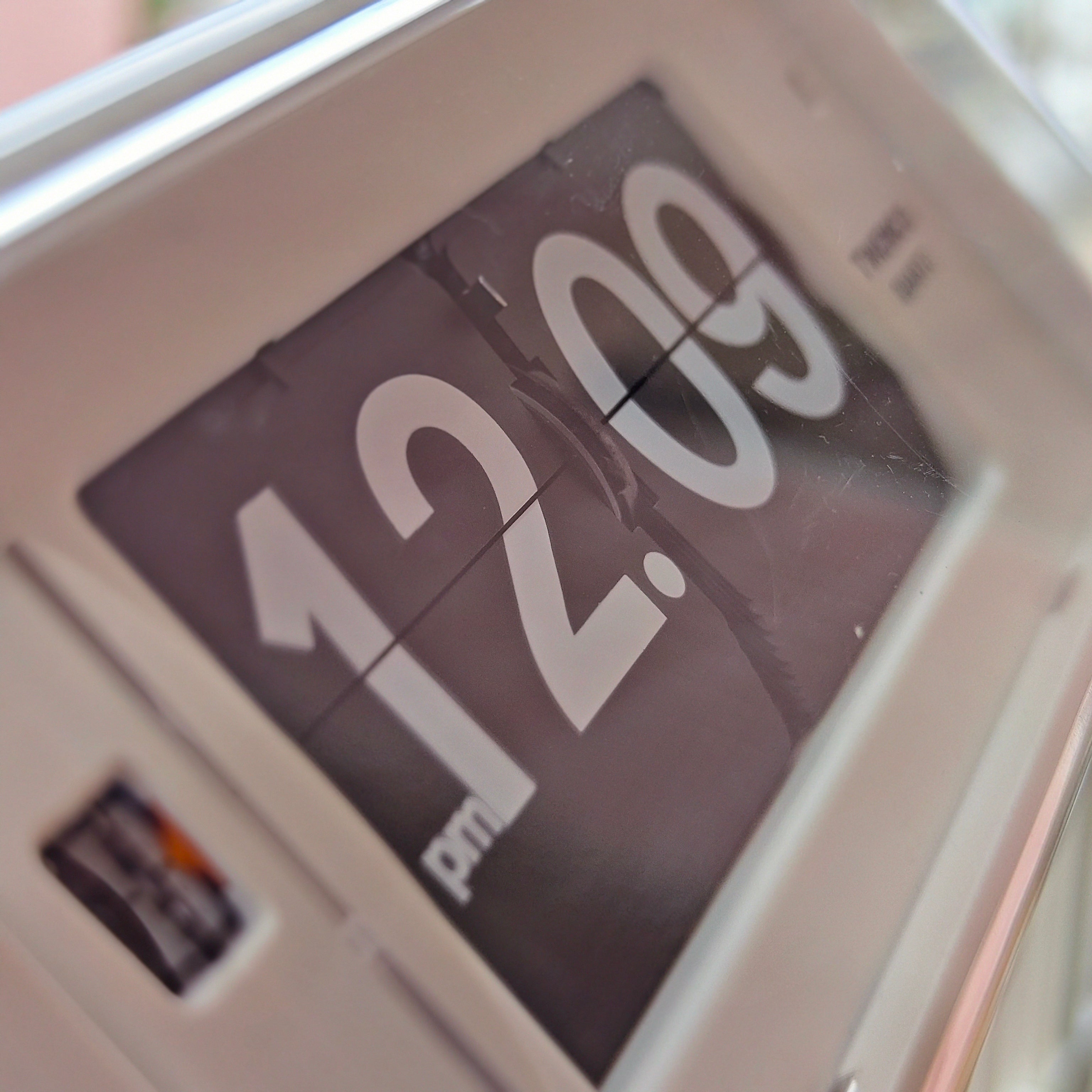
For a single clock above a sofa, start by testing a case width or diameter of about one-fifth to one-quarter of the sofa’s width. A 200 cm sofa, for example, gives you two useful paper templates: 40 cm and 50 cm. Try a larger outline if you want the clock to carry a broad, bare wall; try a smaller one if it will sit with artwork. These are starting points for comparing sizes in your room, not installation standards or rules every clock has to follow.
The size you choose has to do three jobs: fit the available wall, look in proportion to the seating, and show the time from wherever you expect to read it. A clock that passes only the first test can still feel wrong once it is on the wall.
Measure the sofa and the usable wall
For a straight sofa, measure the width across the outside of the arms. If the sofa sits under a clear stretch of wall, that measurement is a useful reference for the clock. You do not need to include the side tables unless they are part of a deliberately unified arrangement that the clock will sit over.
On a sectional, measure the backrest span you are treating as the anchor. A chaise may extend into the room or to one side without adding much to the section of wall the clock actually occupies. If you calculate from the entire furniture footprint, you can end up choosing a clock that feels oversized above the main seats.
Next, measure the available wall above that span. A sconce, tall bookcase, window frame or sloping ceiling can narrow the area where the clock looks comfortable. Compare the candidate’s full case width and height with that usable area, leaving room around it. A wide wall does not help if the free space is shallow.
Pick two sizes to test, not one size to buy
Use the table to make a pair of templates. The smaller outline represents roughly 20% of the sofa width; the larger is about 25%. Those figures are an editorial starting point for a single clock. If one template already looks crowded or both seem too quiet, the wall and clock design are telling you to adjust the range.
| Sofa or main seating span | Smaller template | Larger template |
|---|---|---|
| 160 cm (about 63 in) | 32 cm (about 13 in) | 40 cm (about 16 in) |
| 200 cm (about 79 in) | 40 cm (about 16 in) | 50 cm (about 20 in) |
| 240 cm (about 94 in) | 48 cm (about 19 in) | 60 cm (about 24 in) |
Measure across the widest point of a round clock, including its rim. For a rectangular clock, compare the full width and height. A 50 cm circle occupies a much taller patch of wall than a 50 cm wide, 20 cm tall rectangle. They may share a width on a product page, but the rectangle can fit where the circle leaves too little space above the cushions.
If your sofa is 200 cm wide and the wall feels empty with the 50 cm template, try 60 cm as a third comparison. If the wall is broken up by a pair of sconces, try 35 cm or a lower profile instead. A change of shape can solve a fit problem without reducing the width of the display you want to see.
Size a single clock and a gallery wall differently
A clock on its own has to hold the space you give it. An open, low-contrast outline may need more room to make an impression, while a dark rim or bold numerals can give a smaller case enough presence. For a modest sofa, the Wabi-Sabi Wooden Wall Clock with marker dial is an example of a quiet round form you can compare in different sizes. Judge its outline and dial separately; a wood tone that suits the room does not guarantee the markers will be clear from the far chair.
In a group, measure from the left edge of the leftmost piece to the right edge of the rightmost piece, gaps included. On a 200 cm sofa, a 35 cm clock, two 30 cm frames and two 8 cm gaps make a group 111 cm wide. That clock can look comfortably in proportion as part of the group even if it seems too small alone.
Better Homes & Gardens’ guide to arranging wall art discusses the familiar two-thirds furniture-width guideline for art. You can use that as a comparison for the overall spread of a wall arrangement. On a 200 cm sofa it would be roughly 133 cm across. Applying it to the diameter of the clock alone would mean a 133 cm clock, which is a very different decision. If you are still choosing between one piece and a group, see our guide to styling a clock above a sofa.
Check the display, not just the case
Consider two clocks with the same outside dimensions. One has a wide frame and small, fine hands; the other has a narrower frame and strong numerals. The second may be easier to read across the room even though neither clock is bigger. For a calendar or flip display, decide whether you need to read the time alone or the smaller day and date fields as well.
Stand where you will most often glance at the clock, perhaps in the kitchen doorway or an armchair opposite the sofa. Check whether the face is visible at that angle. Light from a window or lamp can also change how clearly you see the hands behind glass. If the clock is hard to read, compare a clearer display before ordering a larger case. The wall clock collection lets you compare round dials and rectangular displays; the general wall clock sizing guide goes further into choosing for other walls and viewing distances.
Make the final comparison at full size
Cut the two outlines from paper and mark the approximate face area inside each. Borrow the method from IKEA’s guide to planning a picture wall with paper templates. Try each template at the same position before moving it up or down; otherwise it can be difficult to tell whether size or placement made the difference.
- Look from the doorway. Does the silhouette feel connected to the sofa, and is there room between it and nearby fittings?
- Look from your main viewing seat. Could you read the actual hands or digits at this distance? A blank paper shape checks scale; it cannot confirm legibility or glare.
- Check vertical room. Compare the clock’s height and depth with the available space above the backrest, including any moving headrests.
- Check the exact variant before buying. Confirm the outside dimensions, weight and manufacturer’s mounting instructions. If the larger option fits visually but cannot be securely mounted in that spot, choose a different model or location.
When both templates work, use the smaller one for a quieter accent and the larger one if the clock is meant to be the room’s main feature. Keeping both shapes up long enough to see them in daylight and evening light can make that choice much easier.
Frequently Asked Questions
Is a 30 cm clock too small over a three-seater sofa?
It depends on the sofa’s actual width and the role of the clock. Over a 200 cm sofa, 30 cm is 15% of the span. It may look understated as a single piece, but can work with nearby frames or a wall light. Compare it with a 40 cm template before deciding.
Is a 60 cm clock too large over a 200 cm sofa?
At 30% of the sofa width, it is a plausible statement size on an open wall. Test a 50 cm and a 60 cm outline together. If the larger circle crowds the ceiling line, sconces or sofa back, consider the smaller size or a shallower rectangular case.
Should a clock be two-thirds as wide as the sofa?
There is no need for a single clock to span two-thirds of the sofa. That proportion is often used when thinking about artwork or a group of objects. Compare the clock’s case, the total width of any group and the available wall as separate measurements.