You sit down to answer one email. Suddenly it’s dark outside, your coffee is cold, and three hours have disappeared.
For many people — especially those with ADHD, highly creative work styles, or heavy digital habits — time doesn’t feel linear. Minutes and hours blur together. Psychologists often call this time blindness: difficulty sensing the passage of time, estimating duration, or transitioning between tasks.
Ironically, modern technology may make it worse.
Phones, laptops, and smartwatches display time silently. A small number in the corner of a screen demands active attention. If you’re focused, stressed, or doom-scrolling, your brain simply filters it out.
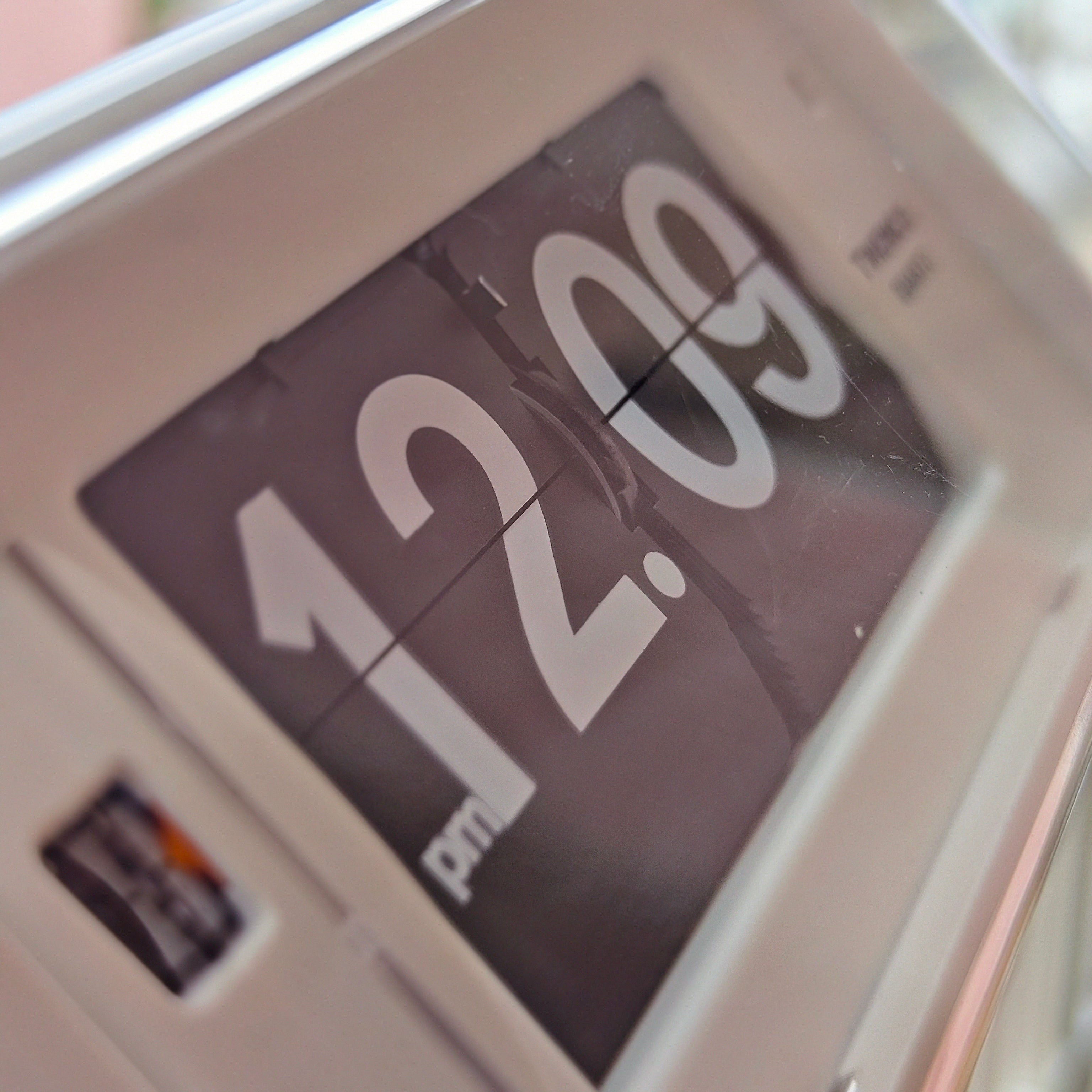
An analog flip clock works differently.
And one unexpected feature may matter most:
The sound.
That small mechanical “thwack.”
What Is Time Blindness?
Time blindness isn’t laziness or poor discipline.
It describes a disconnect between objective time (what the clock says) and experienced time (what your brain feels). Common signs include:
- Underestimating how long tasks take
- Missing appointments despite good intentions
- Hyperfocusing for hours without noticing
- Constantly feeling rushed or behind
- Difficulty transitioning between activities
Our brains rely on external cues to track passing time. Historically these cues were everywhere:
- Church bells
- Factory whistles
- Sunrise and sunset
- School bells
- Mechanical clocks chiming
Modern life removed many of them.
Now, time is mostly silent.

Digital Clocks Show Time. Flip Clocks Announce It.
A phone displays:
14:37
A flip clock performs:
14:36 → THWACK → 14:37
That tiny event matters.
Each flip creates three sensory signals:
- Visual movement — you notice change
- Physical sound — a soft mechanical cue
- Rhythm — repeated intervals build awareness
Your brain doesn’t need to actively check the clock.
The clock interrupts gently:
Another minute passed.
Not urgently. Not with a notification.
Just enough.

Why Small Repeated Signals Help the Brain Track Time
Humans are surprisingly poor at estimating elapsed time in distraction-heavy environments.
Research on attention shows that periodic environmental cues improve temporal awareness because they break continuous focus.
Think about working near:
- A train passing every hour
- Rain hitting windows
- A café announcing closing time
- A ticking clock
These create temporal anchors.
Flip clocks do something similar, but less aggressively than a ticking analog clock.
Instead of hearing hundreds of ticks, you hear an occasional flip.
The result is often awareness without irritation.
The Difference Between a Tick and a Thwack
Traditional ticking clocks divide time into seconds.
That can increase pressure:
Tick… tick… tick…
Some people find it stressful.
Flip clocks compress time into larger chunks:
One minute completed.
That changes the feeling entirely.
The sound becomes less about countdowns and more about progress.
Many owners describe flip clocks as calming because the movement feels:
- Intentional
- Mechanical
- Slow
- Predictable
Almost like a room breathing.

Why This Matters for Deep Work
Productivity advice usually focuses on apps:
- Focus timers
- Pomodoro tools
- Screen blockers
- Notifications
But external physical cues can sometimes work better because they require zero interaction.
A flip clock on a desk quietly answers questions your brain asks subconsciously:
- How long have I been here?
- Am I drifting?
- Is it time to switch tasks?
You don’t need to open another app.
You simply notice.
That’s one reason analog productivity tools have returned in popularity: notebooks, paper planners, mechanical timers, and flip clocks all make time feel more tangible.
The Psychology of Audible Progress
There’s another effect:
Humans like evidence of movement.
Crossing off lists feels satisfying because it signals completion.
The flip sound acts similarly:
Minute finished.
Over hours, those tiny completions create rhythm.
For people who struggle starting or stopping tasks, rhythm can be more useful than strict scheduling.
Can a Flip Clock Replace Time Management Systems?
No.
A clock won’t solve chronic lateness, overwhelm, or executive function challenges on its own.
But environments influence behavior more than many people expect.
Small environmental changes often outperform complicated systems.
Examples:
- Putting a book beside the bed increases reading
- Keeping fruit visible changes eating habits
- Removing notifications improves focus
- Adding physical time cues may improve temporal awareness
A flip clock belongs in that category.
Not a cure.
A subtle nudge.
Why Mechanical Time Feels Different
The appeal of a flip clock isn’t nostalgia alone.
It’s visibility.
Modern devices hide the passage of time behind static numbers.
Flip clocks reveal it physically.
You see time move.
You hear time move.
And occasionally, that soft thwack is enough to pull you back into the present moment.
Not:
“You’re late.”
More:
“Another minute has passed.”
There’s a difference.
Final Thought
In a world full of silent screens and endless scrolling, the sound of a flipping card is strangely grounding.
The mechanical thwack doesn’t demand attention like an alarm.
It simply reminds you that time is moving — gently, steadily, and whether you notice or not.
For people who struggle with time blindness, that quiet reminder may be more useful than another productivity app.