If a glowing clock display keeps catching your eye at night, the best bedroom clock is usually not the one with the most features. It is the one that stays visually quiet when you are trying to sleep.
For the least light, choose a non-luminous analogue clock or a physical flip clock with printed cards. If you need to read the time in darkness, look for an LCD model whose backlight activates only when requested rather than an always-on LED display. Then check the second issue that matters in a bedroom: sound. A clock can be dark but still distracting if it ticks, flips loudly or has buttons that beep.
This guide focuses on light first. If noise is your main concern, our separate guide to the best silent clocks for light sleepers goes deeper into movement sound and ticking.
Why a small clock can feel surprisingly bright
A bedside display sits within your normal field of view, often only an arm's length away. That makes brightness, contrast and viewing angle more important than the size of the screen alone. A display that looks restrained in a bright shop can become the brightest object in a dark bedroom.
The US National Heart, Lung, and Blood Institute's healthy sleep guidance recommends avoiding bright artificial light before bed and keeping the bedroom quiet, cool and dark. Harvard Health also notes that light at night can affect circadian timing, with blue wavelengths generally having a stronger effect than warmer light of comparable exposure. Its practical guidance includes avoiding bright screens before bedtime. See the Harvard overview of blue light and sleep.
That does not mean every illuminated clock will disturb every sleeper. Brightness, colour, duration, distance, direction and personal sensitivity all matter. It does mean an always-on display deserves closer attention than a product photograph usually gives it.
The best bedroom clock types for a low-light room
1. A non-luminous analogue clock: best for zero emitted light
A conventional dial with printed numerals does not need to glow. It reflects the room's available light, so once the lights are off it largely disappears. This is the simplest option for people who want the bedroom as dark as possible.
The trade-off is equally simple: you may not be able to read it in total darkness. That can be an advantage if checking the time encourages anxious clock-watching, but it is a drawback if you need instant nighttime visibility. Also confirm that the hands and hour markers are not luminous if your goal is genuinely zero glow.
For a bedside surface, the Silent Metal Table Clock combines a compact analogue dial with a movement described as quiet, without introducing a digital screen. The MUJI Station Alarm Clock is another screen-free format with a clear dial and alarm function. Choose between them based on whether you need an alarm and how much table space you can spare.
2. A physical flip clock: best for a readable, screen-free display
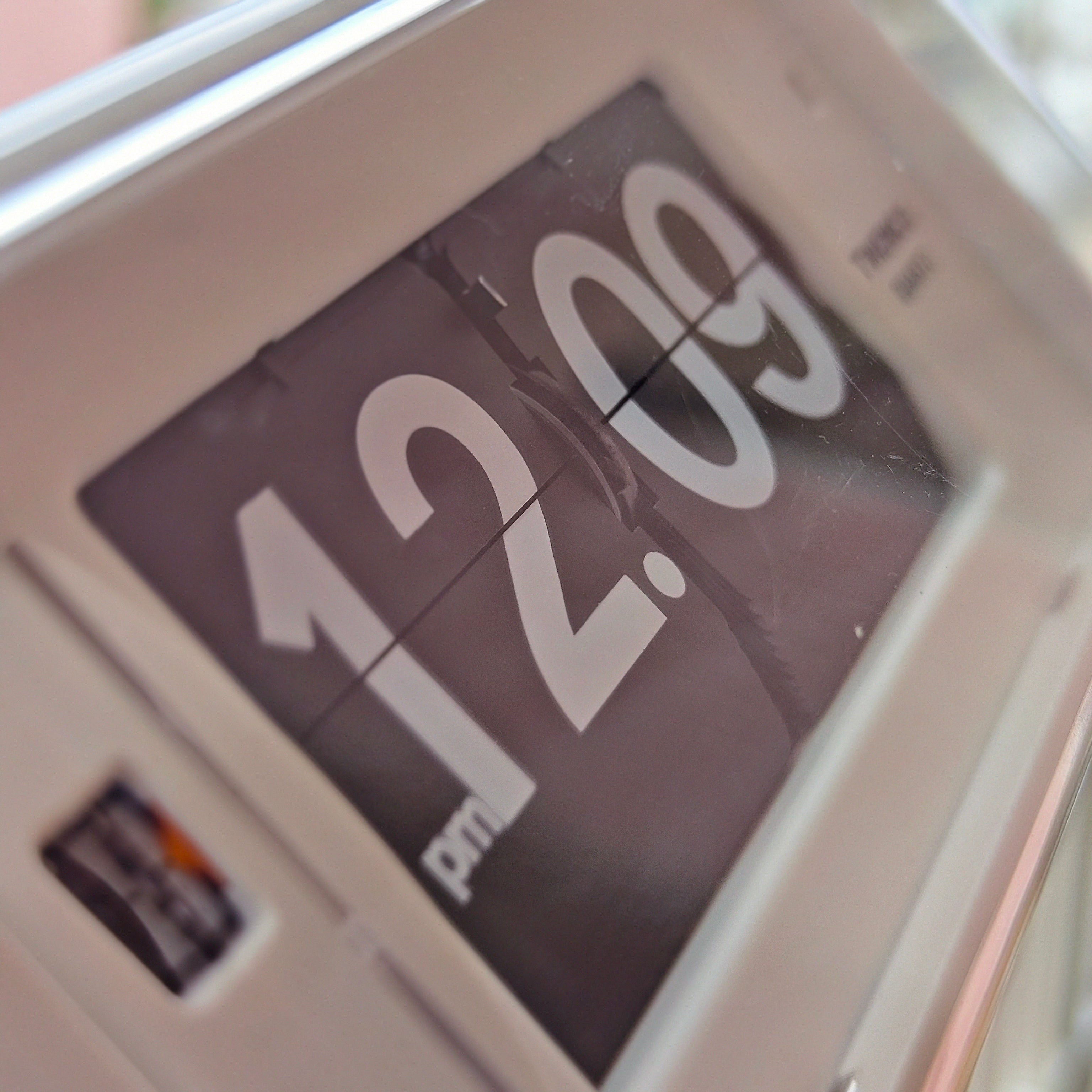
A genuine flip clock shows time on printed cards rather than illuminated pixels. In ambient light, the large high-contrast numerals can be easier to scan than small analogue hands. When the room goes dark, the display does not continue shining into the room.
The compromise is sound. A physical mechanism releases a card as the time changes, so even a well-made clock is not equivalent to a silent, static dial. People who enjoy a brief mechanical cue may find it unobtrusive; light sleepers may not. Our comparison of mechanical flip clocks and digital flip displays explains why the two formats look similar in photos but behave differently at night.
If you want a bedroom alarm as well as a physical display, the TWEMCO AL-30 alarm flip clock is the relevant format to consider. Its printed cards avoid an always-on screen, but the flipping action and alarm are part of the ownership experience. Do not choose it on appearance alone if you are highly sensitive to sound.
3. An LCD clock with an on-demand backlight: best for occasional night checks
An LCD can be a good middle ground when the display remains unlit until you press a button. You get a dark bedside most of the night and temporary visibility when needed. This is very different from an LED display that produces its own light continuously.
Check the exact operating instructions before buying. Product descriptions often say “backlight” without explaining its duration, brightness, colour or whether an automatic night mode can be disabled. Look for a model that returns to an unlit state quickly and does not require several button presses at 3 a.m.
The Pebble Dual Alarm Clock & Timer combines a clear LCD, dual alarms, adjustable alarm volume and a backlight in a compact bedside format. Because the listing confirms the presence of a backlight but not every detail of its night behaviour, verify how it activates before treating it as a no-glow solution.
4. A wall clock outside your direct sight line: best when the nightstand is the problem
Sometimes the display technology is not the main issue; placement is. Moving a non-luminous clock to a wall can keep the bedside clear and reduce the urge to check the time repeatedly. A wall clock also gives you more freedom to angle the face away from the pillow.
A compact Silent Metal Wall Clock can suit a bedroom where a dial is useful during the day but should recede at night. Confirm the mounting position from the bed before drilling: the clock should be readable when you want it, but it need not occupy the most prominent sight line.
A quick comparison
| Clock type | Nighttime light | Dark-room readability | Main trade-off |
|---|---|---|---|
| Non-luminous analogue | None emitted | Low without room light | May be unreadable in darkness |
| Physical flip clock | None from printed cards | Low without room light | Card change can be audible |
| LCD with brief backlight | Only when activated, if designed that way | Good during backlight | Operation varies by model |
| Always-on LED | Continuous | Excellent | Can remain visually intrusive even when dimmed |
What to check before buying
- Does the display emit light continuously? “Digital” is not specific enough. An unlit LCD behaves very differently from an LED display.
- Can the brightness reach true off? A low setting may still feel bright once your eyes adapt to darkness.
- Is the backlight manual, timed or automatic? Prefer a brief, deliberate activation if you only need occasional visibility.
- What colour is the light? Warm amber or red light may feel less sharp than cool white or blue, but intensity and duration still matter.
- Does it have luminous paint? An analogue clock can still glow if the hands or markers use luminous material.
- How does it sound? Check ticking, flip-card changes, alarms, button beeps and snooze operation. Light and sound should be evaluated separately.
- Can you operate it half-awake? Alarm and backlight controls should be easy to find without turning on a lamp.
- Will the display face you directly? A small change in angle or distance can reduce perceived brightness without reducing usability.
Three sensible buying profiles
You want the darkest possible bedroom
Choose a non-luminous analogue dial and accept that it will not be readable in full darkness. Place it outside your direct sight line. This is the cleanest solution because there is no light setting to manage and no automatic mode to surprise you.
You want screen-free character
Choose a physical flip clock with printed cards. It offers bold daytime readability and a tactile display without a glowing panel. Listen to the mechanism—or buy only with a clear understanding of the sound—before using one beside a sensitive sleeper. The TWEMCO table-clock collection provides several physical formats, while the broader Craftsman's Choice collection includes analogue, flip and compact bedside options.
You need to read the time at night
Choose an LCD with a short, button-activated backlight rather than an always-on LED. Verify how long it stays lit, whether the light spills across the room and whether the button can be found without looking. If an alarm is essential, also check volume range and whether setup requires activating the display repeatedly.
The best choice is the one that disappears at bedtime
For someone who hates bright screens, the strongest default is a non-luminous analogue clock: it tells time during the day and contributes almost nothing to the room after lights-out. A physical flip clock is the more expressive screen-free choice, provided its sound suits you. An LCD with an on-demand backlight is the practical compromise when occasional dark-room readability matters.
Avoid shopping by labels such as “night clock,” “digital” or “eye-friendly” alone. Look for the actual behaviour: whether light is emitted, whether it can be fully off, how long a backlight lasts and what the clock sounds like in a quiet room. Those details determine whether a clock supports the bedroom or keeps announcing itself all night.
Frequently Asked Questions
What type of clock gives off no light?
A non-luminous analogue clock emits no light of its own. A physical flip clock with printed cards is also non-glowing unless the specific model includes a separate lamp or indicator. Always check the exact product description.
Is an LCD clock better than an LED clock for a dark bedroom?
It can be. A passive LCD that remains unlit until you press a backlight button can keep the room dark most of the time. An LED display is self-lit and usually remains visible continuously, even at a low brightness setting.
Can I read a screen-free clock in total darkness?
Not without another light source, luminous markings or a separate lamp. That is the central trade-off: zero emitted light usually means limited readability after lights-out.
Are flip clocks suitable for light sleepers?
They can be suitable for people who are bothered by light but not by a brief mechanical sound. A physical flip clock changes cards as time advances, so sound-sensitive sleepers should consider a quiet analogue movement instead.
Where should I place a bedroom clock to make it less distracting?
Keep it outside your direct sleeping sight line, angle the face away from the pillow and avoid placing a luminous display close to eye level. A wall position or a farther shelf can be less intrusive than the near edge of a nightstand.