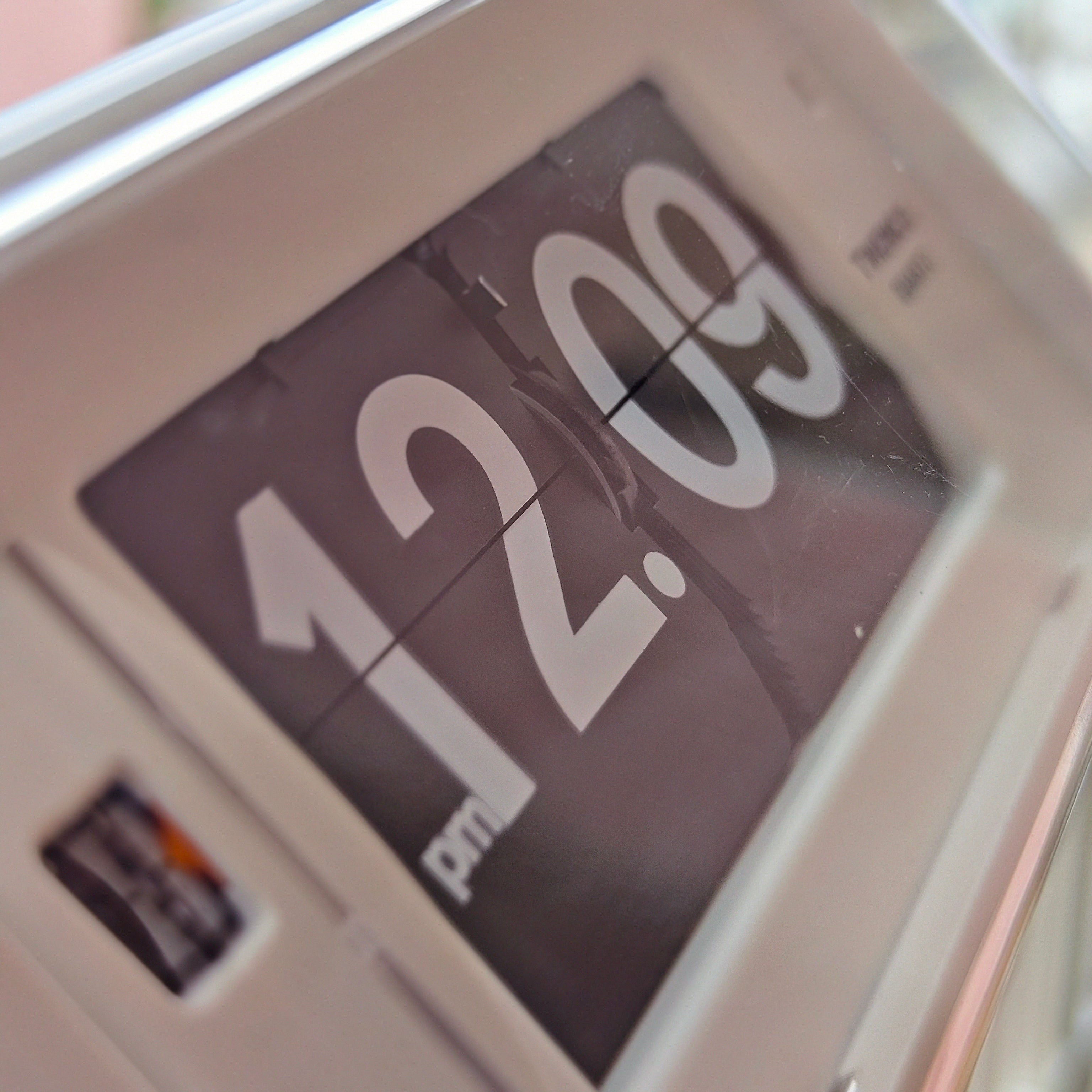
A flip clock is worth it if you value the physical display, visible movement and design presence enough to accept a little sound, more depth and some mechanical care. It is probably not worth it if you simply want the cheapest, smallest or quietest way to check the time.
The decision is less about whether flip clocks are objectively “better” and more about what role the clock will play. As a pure timekeeper, a basic quartz or digital clock can do the job for less. As a useful design object—one that changes the feeling of a desk, shelf or wall—a good flip clock can justify its price every day.
The short answer: who will find one worthwhile?
| Buyer | Is a flip clock worth it? | Main reason |
|---|---|---|
| Design-focused buyer | Usually yes | The movement, typography and depth make it part of the room |
| Screen-free workspace buyer | Often yes | Time stays visible without opening a phone or using a glowing display |
| Light sleeper | Usually no for bedside use | The card change can be audible and most printed displays do not glow |
| Feature-first buyer | Maybe not | A digital clock can offer alarms, brightness control and extra information more compactly |
| Collector | Potentially | Design history, rarity and originality may matter beyond function |
| Lowest-cost buyer | Usually no | You are paying for a physical display and its construction, not only timekeeping |
What value does a flip clock actually add?
A physical experience rather than a screen effect
A real flip clock changes time by moving printed cards or leaves. The display has depth, casts small shadows and creates a brief moment of motion every minute. A split-flap mechanism may contain a housing, drive, gearbox, rotor shaft, rollers and multiple flaps, as illustrated by this split-flap display patent.
You do not need to admire engineering to enjoy the result. The appeal is immediate: time feels like something happening in the room rather than a number being redrawn on a screen. If that physical change is the main reason you want the clock, it has value that a flip-style phone app cannot reproduce.
If you are unsure whether you want real cards or only the visual style, compare a mechanical flip clock with a digital flip display before buying.
Ambient, non-glowing time
Most physical flip cards rely on room light rather than emitting their own light. On a desk or living-room shelf, that can feel calmer than a bright LED display. The time remains available at a glance, but the clock does not demand the same attention as a phone screen.
The trade-off is night-time readability. If you need to see the time in complete darkness, a reflective card display may disappoint unless the model includes a separate light. That is why a flip clock can be excellent in a study and a poor match beside the bed.
Design presence
Flip clocks are rarely visually neutral. Their frames, card packs, numerals and movement give them the character of a small kinetic object. An open model such as the MIDCLOCK Home Decor Flip Clock makes the mechanism part of the composition. A compact enclosed model such as the NeXtime Modern Table & Wall Flip Clock gives a cleaner, more contained interpretation.
That presence is valuable when the clock is meant to anchor a shelf, desk or gallery wall. It is unnecessary when you want timekeeping to disappear into the background.
The practical trade-offs to consider
Sound
A physical card release normally produces some sound. Its volume and tone vary with the card material, mechanism, case and room acoustics. Some owners enjoy the minute click; others notice it immediately in a quiet room.
Do not interpret “quartz” as “silent.” Quartz may describe the timekeeping system while the display still moves mechanically. Our guide to why flip clocks click explains where the sound comes from.
If the clock is for a bedroom, recording studio or sound-sensitive workspace, check the exact model and return terms. A silent analogue sweep clock or an LCD clock may be a safer choice.
Space and placement
A flip mechanism needs physical depth. Even a compact model may occupy more space than a thin LCD clock, while a large metal or calendar display can become a substantial object. Check width, height, depth, weight and mounting method—not only the front-view photograph.
The TWEMCO QT-30, for example, is a compact table clock, while the NeXtime Metal Big Flip clock is a larger stainless-steel model designed for wall or table use. Both display hours and minutes, but they solve very different spatial and decorative needs.
Power and resetting
Many current flip clocks are battery-powered, so they can sit on an open shelf without a cable. Battery type and stated operating period vary by model. You will also need to reset the clock after changing batteries, and some mechanisms should only be adjusted in the direction specified by the manufacturer.
Use the instructions for the exact model. NeXtime maintains a page of product-specific clock manuals, which is the kind of documentation worth checking before purchase. If you plan to keep the clock running continuously, our guide to leaving a flip clock on all the time covers normal use and the exceptions.
Maintenance and durability
A healthy modern flip clock should not require constant attention, but it has more moving display parts than a basic screen. Dust, bent cards, weak batteries, poor alignment or rough handling can interrupt a flip. Owner maintenance should usually stay simple: keep the clock stable and dry, replace batteries correctly and avoid forcing the cards.
Durability depends on construction, environment, parts support and repairability—not merely on price or brand. The Canadian Conservation Institute’s clock-care guidance notes that dust, unsuitable lubrication and untrained disassembly can cause problems, especially with older clocks.
For a fuller ownership view, see our guide to flip-clock lifespan, wear and maintenance.
Is the higher price justified?
Sometimes. A real flip display needs more physical components, assembly and alignment than a simple clock movement or screen. Larger cases, heavier materials, original industrial design, documentation, warranty support and lower production volumes can add cost. Our article on why flip clocks can be expensive breaks those factors down.
But a high price is not evidence by itself. Look for benefits you can identify:
- a clearly described physical mechanism;
- dimensions and materials that match the intended room;
- legible numerals at the distance you will view them;
- published power and operating information;
- a model number, manual and realistic warranty;
- consistent card alignment and finish;
- support or repair options appropriate to the price.
A lower-cost clock can still be worthwhile if it gives you the movement and look you want. A premium clock earns its price only when its size, construction, design or support matters to you. For current options by price tier, use our flip-clock budget guide as a starting point, then verify the latest product details.
When a flip clock is worth buying
A flip clock is a strong choice when several of these statements sound like you:
- You want a clock that also acts as décor.
- You enjoy physical movement and visible mechanisms.
- You prefer ambient time to a continuously illuminated display.
- You have enough space for the clock’s real dimensions.
- You are comfortable with a brief click or flap sound.
- You are willing to follow model-specific setup and battery instructions.
- You have found a design you expect to keep rather than replace quickly.
If you want an accessible way to test the format, the Craftsman’s Choice collection includes design-led options at lower price points. If you already know you want an established range of table, wall or calendar formats, the TWEMCO flip clock collection provides broader model choices.
When you should buy something else
Choose another clock if silence is non-negotiable, you need bright night-time visibility, you want several alarms or data functions in a small case, or the physical movement does not interest you. Those are not minor weaknesses to overlook; they are signs that a different display format fits your needs better.
You should also walk away when a listing does not say whether the display is physical, omits dimensions or power requirements, uses “mechanical” vaguely, or offers no credible support for a costly product. The appeal of flip clocks is tangible, so the product information should be tangible too.
A simple final test
Imagine removing the flip mechanism and replacing it with an ordinary digital display. Would you still buy the clock at the same price? For a side-by-side value test, see our comparison of mechanical flip clocks and digital flip displays.
If the answer is no because the motion, sound, typography and physical cards are exactly what you value, then the flip clock may be worth it. If those qualities feel secondary, choose the quieter, smaller or less expensive clock that meets your practical needs.
Frequently Asked Questions
Are flip clocks good for everyday use?
Yes, a healthy modern flip clock can be used as an everyday timekeeper. Choose the correct placement, use the specified power source and follow the model’s setting instructions.
Are flip clocks too noisy for bedrooms?
They can be. The card change is normally audible, although volume varies by model and room. Light sleepers should test the exact clock or choose a display with silent minute changes.
Do flip clocks last a long time?
They can last for many years, but there is no universal lifespan. Build quality, handling, environment, battery care, parts availability and repairability all affect service life.
Are expensive flip clocks always better?
No. Higher prices may reflect materials, scale, design, lower production volume or brand positioning. Judge the exact construction, specifications, warranty and support rather than price alone.
Should I buy a mechanical or digital flip clock?
Choose a physical flip clock for real motion, tactile character and a non-glowing display. Choose a digital version for silence, compact size, night-time visibility and extra functions.