Shopping for a “vintage clock” and a “retro clock” can lead to very different expectations. One term usually points to an object from an earlier period; the other describes a look that draws on the past. A clock can be old without looking retro, and a new clock can look retro without being vintage. Knowing which meaning a seller intends helps you judge age, condition and style separately.
The short answer: vintage describes age; retro describes style
In clock listings, vintage is best treated as a claim about when the clock was made: an original object from a past period, ideally with a date or evidence to support it. Retro describes a design that recalls an earlier period. It can be an original from that period, a later reproduction, or a newly made design that borrows its visual language. The words are often used loosely in retail, so read the description for evidence rather than treating either label as a specification.
Dictionary definitions reflect this difference. Dictionary.com’s entry for “vintage” includes objects representative of a past time, while Collins defines “retro” design as a style of an earlier time that has been revived. These are useful guides, not a universal clock-industry age standard: there is no single year at which every clock becomes vintage.
What makes a clock vintage?
A vintage clock is generally an older clock made during the era it represents. The most useful question is not “Does it look old?” but “What evidence supports its date and origin?” Look for a maker’s name, model number, serial or date code, labels, original packaging, catalog records, service papers, or a reliable seller description that explains how the date was established. A single feature such as a yellowed case or an aged-looking dial is not enough; wear can be imitated, and parts may have been replaced.
Age and condition are separate. A clock may be genuinely old but heavily restored, incomplete, or no longer working. A well-preserved example may have replacement parts. Ask what has been repaired, whether the movement and case are original, and whether the clock has been tested. If you are buying a vintage clock as a collectible, documentation and condition matter more than a convincing period look.
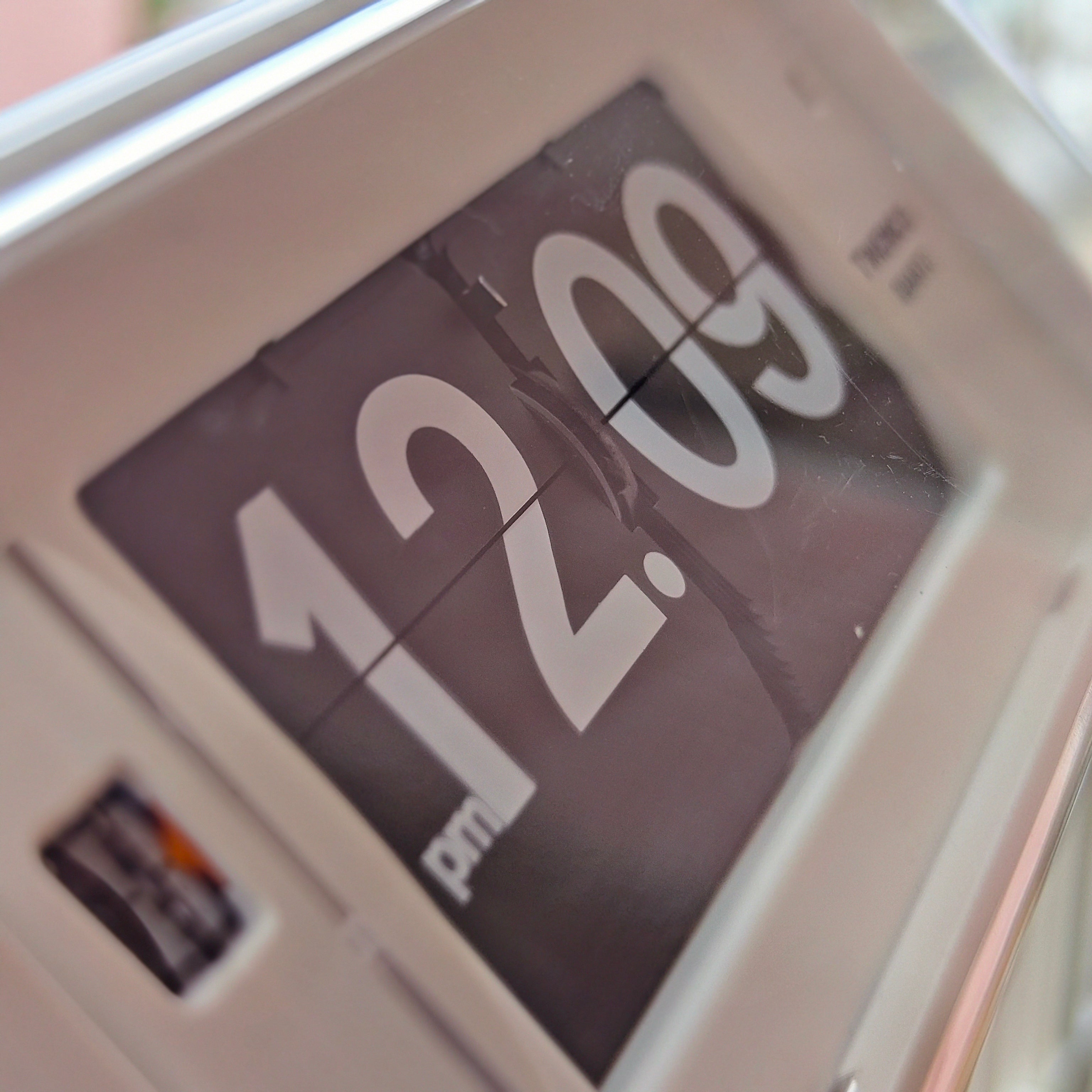
For example, our listing for the 1976 Japanese COPAL Flip Clock AP-110 identifies it as a 1976 model. That date claim is what makes “vintage” meaningful here; the styling alone would not establish its age. Our vintage flip clock collection groups older examples, including Japanese COPAL models.
What makes a clock retro?
A retro clock looks back. Its shape, colors, numerals, materials, or overall mood may echo a past decade, even if the clock itself was made recently. A contemporary product can therefore be retro in style without being an antique or vintage original. Likewise, a genuine older clock can be described as retro when its appearance is being discussed rather than its date.
There is no requirement for a retro design to copy one specific model exactly. It may combine period cues with newer materials or construction. An ethnographic study of retro furniture retail describes how sellers and enthusiasts recontextualize older styles and objects, showing that “retro” also works as a design and cultural category, not simply a manufacturing date. The study concerns furniture retail in the UK, so it offers context for the term rather than a clock-specific rule.
Our retro clock collection is organized around nostalgic design. A newer decorative clock such as the MIDCLOCK Home Decor Flip Clock can suit a retro-inspired room without being represented as an original from a past decade.
Vintage, retro and reproduction: how the terms relate
Reproduction describes a later object made to copy or closely repeat an earlier design. It tells you about the relationship between the object and its reference, not necessarily its quality. A reproduction may be carefully made; it is still not an original from the period it imitates. A revival or inspired-by design may borrow cues more freely instead of copying a specific original.
These labels can overlap. A clock made decades ago in a style inspired by an even earlier era may be both vintage and retro. A newly made reproduction of a 1950s clock may be retro in appearance but not vintage. The Metropolitan Museum of Art provides a clear example from another decorative-art category: it catalogs a 19th-century textile as a “reproduction of 16th century design.” The object’s date and the period of its design reference are different facts. The same distinction is useful when evaluating clocks.
How to judge a clock listing
- Separate the claim from the appearance. Ask the seller to state the clock’s approximate or exact production date, maker and model. Treat “retro,” “classic,” or “vintage style” as design language unless the listing also supports an age claim.
- Look for evidence. Check labels, model markings, serial numbers, documented ownership, original manuals, and dated catalogs. A seller’s confident adjective is not provenance.
- Ask what is original. Find out whether the case, dial, movement, hands or flip mechanism have been replaced, repaired or refinished. A restoration can be worthwhile, but it should be disclosed.
- Assess condition and function separately. Request clear details about cracks, corrosion, missing parts, inaccurate timekeeping, noise, and repairs. “Working” does not automatically mean original or fully serviced.
- Compare like with like. When price or collectibility matters, compare the same maker and model, with similar condition and documented completeness. A retro style alone does not establish rarity or value.
If you want the visual contrast between old and contemporary pieces, our guide to vintage versus modern clock design explores the aesthetic side. For practical placement and scale in a current room, see how to style a flip clock in a modern interior.
Which one suits your room?
Choose vintage when you want an object with a particular history, materials, and signs of use, and you are comfortable checking its condition and maintenance needs. Choose retro when you want a period-inspired silhouette or color palette, with the convenience and consistency of a newer object. Reproductions can bridge the two: they bring a historical design into a room while remaining products of a later date.
For styling, use the clock’s actual presence as your guide. A large, high-contrast face can act as a focal point; a compact model may work on a shelf among books and ceramics. Pair a vintage piece with modern furniture to make its age legible, or repeat a few period cues around a retro design so it feels intentional rather than themed. If a clock is a collectible purchase, verify the date and condition first; if it is mainly décor, prioritize proportion, readability and how it sits with the room.
Frequently Asked Questions
Is a retro clock vintage?
Not necessarily. Retro describes a past-inspired look; vintage usually refers to an original clock made in an earlier period. An older clock can be both, but a new retro-styled clock is not vintage just because it looks old.
Is there a fixed age when a clock becomes vintage?
No single cutoff applies across all clocks and sellers. Ask for the clock’s production date and evidence, and treat “vintage” as a broad description unless the listing defines it more precisely.
What is the difference between a vintage clock and a reproduction?
A vintage clock is an original object from an earlier period. A reproduction is made later to copy an earlier design. A reproduction can look period-correct, but its manufacture date belongs to its own era.