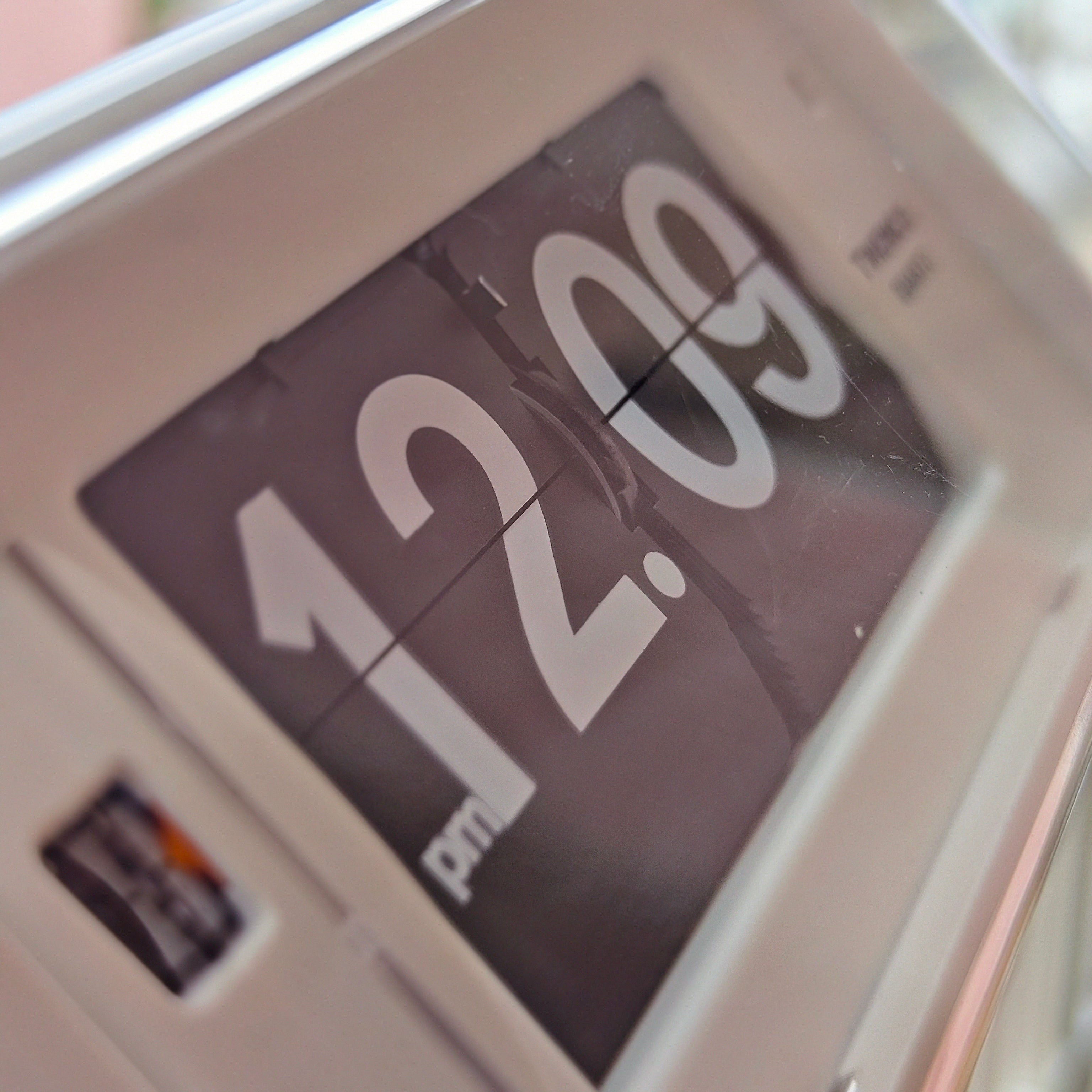
A good study-desk clock should make time easier to understand without becoming another source of noise, light or notifications. The best choice is not necessarily the model with the most functions. It is the one you can read quickly, place comfortably and use without interrupting the work in front of you.
For most students, the strongest setup is either a compact silent clock for ambient timekeeping or a simple clock paired with a dedicated timer for focused sessions. A flip clock adds more visual character and distance readability, while a small LCD clock works well when you also need a date, alarm or countdown.
Quick comparison: which type suits your study desk?
| Clock type | Best for | Main advantage | Check before buying |
|---|---|---|---|
| Silent analogue desk clock | Reading, writing and quiet rooms | Low visual demand and no glowing display | Dial size, contrast and verified quiet movement |
| Compact LCD clock | Small desks and students who want extra functions | Time, date, alarms or timer in one object | Display clutter, viewing angle and backlight behaviour |
| Mechanical flip clock | Design-led desks and easy distance reading | Large physical numerals and strong visual presence | Footprint and whether the periodic flip sound distracts you |
| Dedicated visual timer | Time-boxing, revision blocks and breaks | Makes a work interval visible without opening a phone | Maximum duration, alert volume and control simplicity |
| Wall clock near the desk | Very small desks | Keeps the work surface completely clear | Sightline, mounting position and readability from the chair |
What makes a clock good for studying?
1. It is readable in one glance
A study clock should answer a simple question—what time is it?—without making you lean forward or decode a busy display. High contrast, clear numerals and a suitable size matter more than decorative complexity. Test the likely viewing distance: a clock that looks clear in a product close-up may feel small at the far corner of a desk.
Consider the angle as well. LCD displays can lose contrast when viewed from above or from the side, while an analogue dial or flip display may remain legible across a wider range. If you frequently move between handwriting, a laptop and reference books, position the clock where it remains visible from your normal working posture.
2. It matches your tolerance for sound
Some students barely notice a ticking movement; others find it impossible to ignore in a quiet room. A sweep-style analogue clock can reduce repetitive ticking, but “silent” should still be treated as a model-specific claim. A mechanical flip clock creates a brief sound as the cards advance. That small event can be satisfying, neutral or distracting depending on the person and the room.
If sound sensitivity is your priority, start with a purpose-built quiet model such as the Silent Metal Table Clock, then keep any alarm or timer alert at a level that is noticeable without being startling.
3. It avoids unnecessary light
A constantly illuminated display can compete with a page or monitor, especially during evening study. A non-lit dial, passive LCD or physical flip display keeps the clock visually quieter. If you need a backlight, a press-to-light design is usually less intrusive than an always-on display. Check whether the brightness is adjustable and whether the light turns off automatically.
4. It fits the real desk, not the imagined one
Measure the available footprint after placing your laptop, notebooks and lamp. Leave room for your hands and for books to open flat. A clock with a small base can still be visually dominant if it is tall; a wide flip clock may be easy to read but unsuitable beside a large monitor. If every centimetre matters, a magnetic clock or a nearby wall clock can move timekeeping off the main work surface.
5. Its functions support a routine
Extra features are useful only when they remove friction. A countdown helps with planned work intervals. An alarm can mark a class or appointment. A date display can orient a long revision schedule. But menus, blinking icons and frequent button presses can create more interruption than value.
Cornell University's study-strategy guidance encourages students to experiment with structured approaches and adapt habits as coursework changes. Choose functions that support the method you already intend to use, rather than buying a complicated clock and hoping the features create the habit for you.
The best clock types for different study styles
Best for deep reading: a silent analogue clock
For long reading or writing sessions, a simple analogue dial gives ambient awareness without presenting a row of secondary information. It is especially effective when you want to know roughly how much of an hour remains rather than track every second. Select a high-contrast dial and place it just beyond the main working area so it is available but not central.
Best for a compact multifunction setup: a small LCD clock
A digital desk clock is practical when a small footprint and several functions matter. The MUJI Minimal Digital Desk Clock – Magnetic Edition combines a clear display with time, date and countdown functions, while its magnetic back creates an alternative to using desk space. The Pebble Dual Alarm Clock & Timer is another compact option when separate alarms and a countdown are useful.
Keep the display hierarchy simple. If you only need the current time, a large primary readout is more valuable than weather symbols, multiple zones or decorative animations.
Best for a design-led desk: a flip clock
A physical flip clock turns timekeeping into part of the room. Large printed cards are easy to read, and the changing display provides a restrained sense of movement without becoming a full screen. The trade-off is that the clock usually occupies more depth than a compact LCD model, and the flip action is audible.
The MIDCLOCK Home Decor Flip Clock suits a desk where the mechanism is meant to be seen. If you want a broader model comparison, see our guide to the best flip clocks for a home-office desk. For a wider range of compact and decorative options, browse Twemco table clocks and compare the stated dimensions before buying.
Best for timed focus sessions: a dedicated timer
A timer and a clock do different jobs. The clock provides context across the day; the timer defines a single work interval. Using a dedicated timer can keep that action off your phone and make the remaining block visible at a glance.
The Focus Bar Timer uses a segmented bar to show progress and supports countdown, count-up and repeat modes in a slim format. It can sit beside an ordinary clock rather than replace it. The official Pomodoro Technique describes timed sessions as one part of a broader system that also includes planning, interruption management and reviewing effort; the timer is a tool, not the entire routine. Cornell's Knight Institute similarly discusses structured focus sessions and specific short-term goals.
If you prefer a physical display for ambient time, our guide to using a flip clock with the Pomodoro Technique explains how to pair a clock with a separate timer.
How to choose without overbuying
For a small dorm or shared desk
Prioritise footprint, easy controls and quiet operation. A compact LCD model or small analogue clock is usually the safest choice. If metal shelving is available, a magnetic model can keep the main surface free. Avoid buying a large statement clock before measuring the space you actually control.
For long, quiet solo sessions
Choose the lowest-stimulation option you can read comfortably: a silent analogue clock, passive LCD or non-illuminated flip display. Decide whether a periodic flip is pleasant or intrusive before placing a mechanical clock directly beside you.
For revision built around intervals
Use two layers: a normal clock for the day and a simple timer for the current task. Set the interval before you begin, keep the timer visible but off-centre, and silence other notifications. This makes the study structure clear without turning the desk into a control panel.
For a desk that is part of the room
If the workspace is visible from a living area, the clock can contribute to the interior as well as the study routine. A flip clock or metal analogue clock has more presence than a small utility display. Keep the surrounding objects limited so the clock reads as an intentional focal point, not one more accessory. Our guide to setting up a distraction-free study zone covers the wider relationship between the desk, lighting and visual clutter.
A simple placement test
- Clear the primary work area. Put the laptop, main notebook and lamp in their real positions first.
- Place the clock outside the centre line. It should be easy to glance at without sitting between you and the task.
- Check it in daytime and evening light. Look for glare, weak contrast or an unnecessarily bright backlight.
- Listen for ten minutes. In a quiet room, ticking or motor noise becomes more noticeable than it is in a shop.
- Run one normal study session. Notice whether you use the features or repeatedly adjust them. The best clock becomes part of the environment rather than a new object to manage.
Final checklist
- Can you read it from your usual seated position?
- Is the sound comfortable in the quietest version of the room?
- Does the display stay calm when you are not interacting with it?
- Does it fit without reducing useful writing or book space?
- Are the timer, alarm or date functions genuinely relevant?
- Can you operate it without reaching for instructions every time?
For most study desks, a clear silent clock plus a dedicated timer is the most flexible combination. Choose a flip clock when its legibility and physical character add something you value; choose a compact digital model when space and utility matter most. The right answer is the one that makes time visible while leaving your attention on the work.
Frequently Asked Questions
Is an analogue or digital clock better for studying?
An analogue clock is useful for low-stimulation, approximate time awareness. A digital clock is better when exact time, alarms, a date or countdown matters. Neither format is universally better; choose according to the information you need and the display you find least distracting.
Should a study-desk clock have a timer?
A timer is helpful for structured work intervals, but it does not have to be built into the clock. A separate timer often gives clearer controls and lets the main clock remain simple.
Are flip clocks too noisy for studying?
They make a brief mechanical sound when the cards advance. Many people find it unobtrusive, but sound-sensitive students may prefer a verified quiet analogue movement or passive LCD clock. Avoid assuming any mechanical model is silent.
Where should I put a clock on my desk?
Place it just outside the primary work area, within an easy glance from your normal seated position. Keep it away from the monitor's brightest reflections and avoid using valuable space needed for writing or books.
How big should a study-desk clock be?
Large enough to read from your chair, but small enough to preserve working space. Measure the available width, depth and height after your essential study equipment is in place, then compare those dimensions with the product specifications.