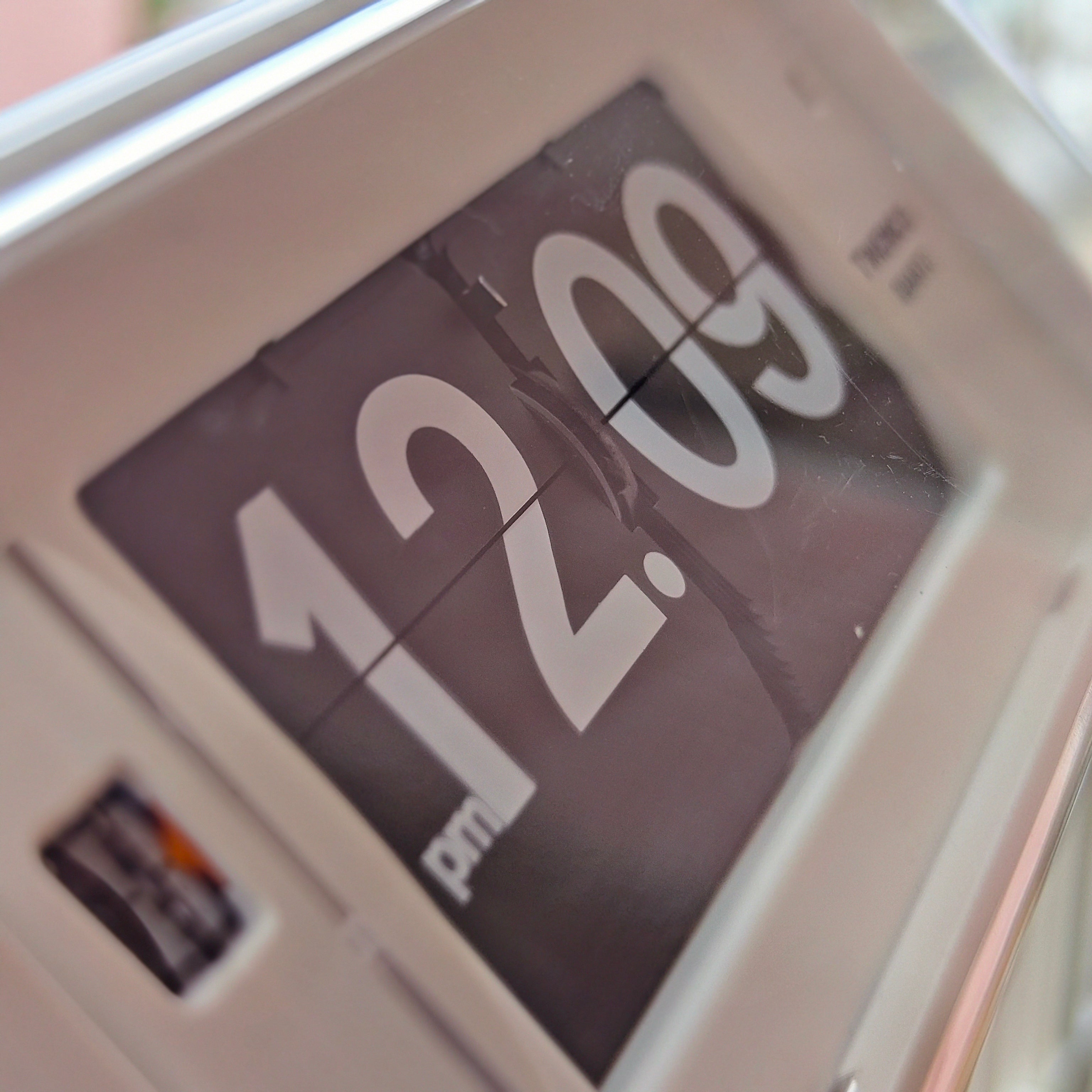
When buying a flip clock, look beyond the colour and the retro typography. Confirm that it has the display you want, fits its intended position, remains easy to read and makes a sound you are comfortable living with. Then check its power requirements, construction, setting procedure and after-sales support.
The most useful flip-clock buying guide is a way to compare specific models. A clock for a quiet bedside table has different priorities from a statement piece across a living room. Decide where yours will live and what it must do before building a shortlist.
A flip-clock buying checklist
| Check | What to confirm before ordering |
|---|---|
| Display and movement | Physical cards or a screen animation; identified timekeeping system |
| Size and mounting | Full width, height, depth, weight and approved placement |
| Readability | Numeral size, contrast, viewing angle and preferred time format |
| Sound | A demonstration of normal operation, especially near a bed |
| Power | Exact batteries or external supply; access and replacement requirements |
| Construction | Stable case or stand, clear card movement and accessible controls |
| Care | Model instructions and a realistic service route |
| Seller and support | Identifiable brand/model, written warranty and return conditions |
| Total purchase | Delivery, availability, accessories and the features you will use |
1. Confirm the display and the timekeeping system
If the physical flip is the reason you want the clock, make sure the listing describes moving cards, leaves or a split-flap display. A digital screen can imitate the same typography and animation without moving any printed cards. Ask for an operating video when the description is ambiguous.
“Mechanical” can describe the display rather than a wound movement. A physical flip clock may still use electronic timekeeping. NIST’s explanation of quartz timekeeping describes how a vibrating crystal provides a repeating signal that the clock counts. The display and the timebase answer different buying questions.
Look for an identified movement and a stated accuracy specification if precision matters. Do not infer accuracy from the number style or the presence of visible gears. Our comparison of physical and digital flip displays explains the format distinction; our flip-clock accuracy guide covers drift and display timing.
2. Measure the complete footprint
Record the clock’s width, height and depth, including its stand and projecting controls. A front-facing photograph can hide how much shelf space a clock occupies. Leave enough room to reach the setting controls and open the battery compartment without disturbing nearby objects.
For example, the TWEMCO QT-30 table flip clock is listed at 195 × 103 × 75 mm. A paper outline of that footprint is more useful than assuming that all compact flip clocks fit the same desk or shelf. Use exact dimensions for each shortlisted model.
For a wall installation, confirm that the clock is designed for wall mounting, then check its weight and the specified fixing method. Our practical wall-clock sizing guide explains how to test scale against usable wall width, furniture and the real viewing distance.
3. Test readability and choose the right format
The case size and the readable display area are not the same thing. Compare numeral height, contrast and how much space is devoted to hours and minutes. A calendar clock may offer useful extra information, but check that its smaller day and date fields are also readable from your normal position.
Think about the places where you will glance at the clock: seated at your desk, across the sofa or standing in a doorway. Request a straight-on and angled demonstration if you cannot see it in person. Reflective covers and surrounding lighting can affect the result.
Choose 12-hour or 24-hour format deliberately, and check the selected variant before checkout. If the clock includes calendar information, confirm the language and how corrections are made. Also ask how it is read after dark: room light, a button-operated light and continuous illumination create different experiences.
4. Listen to the exact model
A flip clock’s sound can be part of its appeal, but that does not make it suitable for every location. Assess the ordinary minute change, any background operating sound and the alarm separately. A demonstration in a busy shop may conceal a sound that is noticeable beside a pillow.
Ask for a video with clear audio and no music, ideally covering more than one display change. Phone recordings cannot give a dependable loudness measurement, so use them to identify the kind of sound rather than to establish a precise volume.
If you are particularly sensitive to sound, confirm the return conditions before relying on a home trial. Avoid treating “quiet” or “silent movement” as a promise that the cards themselves make no sound. Our article on why flip clocks click provides context for that part of ownership.
5. Check power and access
Read the exact battery size, chemistry and quantity. Do not assume a clock uses AA cells because it is small. The QT-30 listing specifies a C-size alkaline battery, while other models have different requirements. Compare published runtime only when the battery set and operating conditions are clear.
Energizer’s battery-care guidance recommends following the device’s battery instructions, inserting cells with the correct polarity and removing exhausted batteries promptly. It also advises replacing a set together with matching new cells and removing batteries for extended periods of non-use.
For an externally powered clock, confirm the appropriate supply and plan the cable route before choosing the position. If it has backup power, check whether that preserves only timing or also the display and alarm. Our battery versus plug-in clock comparison explains those placement and outage trade-offs.
6. Judge construction through details, not material labels
Metal, wood and plastic describe materials; none alone establishes how well a clock is assembled. Look for a stable base, securely fitted case parts, accessible controls and a display that completes its changes without catching or leaving an incomplete numeral. An unedited demonstration is more useful than a photograph of the finish.
Decide whether you prefer an enclosed case or an exposed display. The MIDCLOCK Home Decor Flip Clock is an example of an open design that makes the mechanism part of its appearance. That approach needs a position where books, cables and other objects will not touch the moving cards.
Inspect how the clock rests on its surface and how you would pick it up. For a used clock, request close photographs of the cards, battery compartment, controls and case. Cosmetic wear and reliable operation should be assessed separately; one does not prove the other.
7. Understand setting and long-term care
Find the correct instructions before buying. Check how the time is advanced, whether the clock has an AM/PM sequence and how any calendar is adjusted. Do not assume that a control can turn in either direction, or that printed cards are meant to be moved by hand.
NeXtime’s product-manual directory separates general instructions from model-specific manuals, including flip clocks. That is the kind of support worth checking: instructions should match the product, rather than merely the brand.
For a vintage purchase, ask what was inspected or serviced and who could repair it later. The Canadian Conservation Institute’s clock-care guidance recommends professional assessment when an old clock’s completeness or condition is uncertain. Treat a historic clock as an individual object, not as equivalent to a new model with a similar appearance.
Our guide to flip-clock lifespan and maintenance helps you consider wear, environment and support without assuming a guaranteed service life.
8. Verify the brand, seller and support terms
A recognisable logo is useful, but ask for the exact model identifier and a specification that agrees with the product being sold. Check the selected colour, time format, calendar language and included accessories. A brand name alone does not tell you which version will arrive.
Read the seller’s warranty and return terms separately. Ask who handles a fault, what the written warranty covers, how a claim is submitted and whether you would need to send the clock abroad. Also check any exclusions or different conditions for used, sample or clearance items.
For returns, confirm the time window, permitted condition, packaging requirements and who pays shipping. Do not assume an operating demonstration guarantees a return right, or that a manufacturer's general policy automatically applies through every retailer. Keep the receipt and the written answers that influenced your purchase.
For a design-led shortlist, the TWEMCO flip-clock collection provides different case formats to compare. Apply the same model-by-model checks across the collection rather than assuming identical specifications or features.
9. Pay for the features that matter in your room
Compare the total purchase, including shipping and any required power accessories. Check the current delivery estimate as well as the price. A clock with an ideal appearance but an unsuitable delivery date may not work for a gift or a room project.
Then separate essential requirements from preferences. Easy reading, suitable sound and a workable power arrangement should usually come before an extra calendar function or a finish you will barely notice. Our explanation of what affects flip-clock prices helps put construction and design into context without treating cost alone as proof of quality.
Shortlist two or three models and complete the checklist for each. Resolve missing specifications with the seller before ordering. A good choice is a clock whose everyday operation suits the place you have chosen, whose limitations you understand and whose support terms are clear.
Frequently Asked Questions
How can I tell whether a flip clock uses real cards?
Look for an explicit moving-card or split-flap description and an operating video. A flip-style font or animation on a screen does not establish a physical mechanism.
Can a physical flip clock also use quartz?
Yes. A quartz timebase and a mechanical card display can coexist. Check the model’s movement description and accuracy specification rather than interpreting “mechanical” as battery-free.
What should I check before putting a flip clock beside my bed?
Prioritise normal operating sound, night-time readability, any light function and the alarm you need. Confirm the return conditions if you intend to assess sound at home.
Is a heavier or more expensive flip clock always better?
No. Compare stability, display operation, materials, controls and support. Weight or price alone does not tell you whether the clock fits your use.