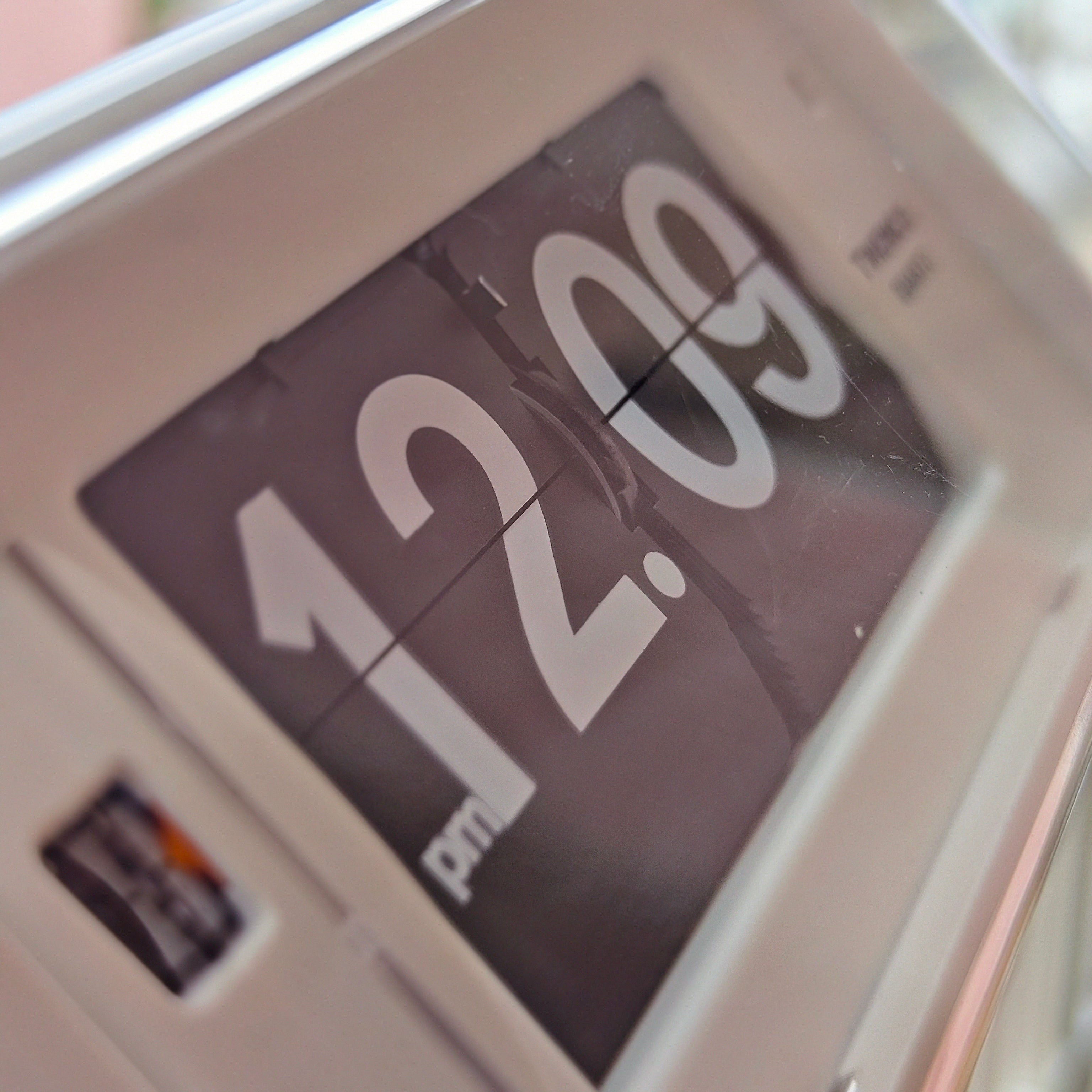
A statement clock has to do more than fill an empty wall. In a large living room, studio or open-plan space, it must remain legible at a distance, hold its own beside substantial furniture and still leave enough visual breathing room to feel intentional.
The best choice is not automatically the biggest clock available. A bold flip display, a warm wooden dial and a framed metal clock create very different kinds of presence. This guide compares six strong options for large rooms and explains how to judge scale before you buy.
Quick answer: the best statement clocks for large rooms
- Best for long sightlines: TWEMCO Jumbo Wall Flip Clock BQ-100
- Best full-calendar statement: TWEMCO Calendar Wall Flip Clock BQ-1700
- Best industrial design: NeXtime Metal Big Flip clock
- Best information-rich square format: Fartech Wall Clock AD-640
- Best quiet, warm alternative: Wabi-Sabi Wooden Wall Clock – Number Dial
- Best graphic metal accent: Bauhaus Vintage Metal Wall Clock
If your priority is general living-room suitability rather than maximum visual impact, start with our broader guide to the best clocks for a living room.
What makes a clock work in a large room?
Presence is a relationship, not a diameter
A clock reads as a statement piece when its scale makes sense relative to the wall, nearby furniture and viewing distance. A 40 cm dial may feel substantial over a narrow console, yet look lost above a long sectional sofa. A rectangular flip clock can appear larger than a round clock of similar width because its case, typography and depth give it more visual mass.
There is no universal wall-to-clock ratio. Even specialist wall-clock guides recommend assessing the available wall and letting an oversized clock remain the dominant object rather than crowding it with competing décor. A useful reference point is Newgate’s guide to clock scale in different rooms, which places large clocks around 45–60 cm in living rooms and open-plan spaces. Treat that as a starting range, not a rule.
Legibility matters as much as case size
Large rooms create longer sightlines. High-contrast numerals, generous digit height and a simple layout can make a clock readable from farther away than a physically larger but busier design. Consider where you will actually read it: from the sofa, across a studio, through an open-plan kitchen or from a reception entrance.
For example, The BQ-100 product specifications list 100 mm number plates, 70 mm digits and readability over 40 metres. That makes the format useful when the clock needs to function across a genuinely broad space, not merely decorate a close-range seating area.
Depth and movement add visual weight
Mechanical flip cards give a clock a small moment of motion and a recognisable sound. A deep case also casts stronger shadows than a thin dial. Both qualities can help an object feel architectural, but they are not right for every room. If the space is used for reading, recording or quiet work, consider whether the flip sound will be welcome. A silent-sweep analogue model gives visual scale without the periodic click.
Six statement clocks worth considering
1. TWEMCO Jumbo Wall Flip Clock BQ-100: best for long sightlines
The BQ-100 is the clearest choice when large-room legibility comes first. Its 476 × 280 × 163 mm case is broad and unusually deep, while the 70 mm digits have the high contrast of a classic institutional flip display. At 2.5 kg, it has enough physical presence for a large wall without becoming a full calendar board.
This model works particularly well in an open-plan living area, loft, studio or long hallway where people approach from different angles. The design is visually direct: time is the main graphic, with no extra calendar information competing for attention. The official Series 100 data supports its stated long-distance readability, but the bold case and moving cards are what make it feel like an object rather than signage.
Choose it if you want the clock to be both focal point and practical time display. Browse the wider TWEMCO wall clock collection if you like the format but need a smaller footprint.
2. TWEMCO Calendar Wall Flip Clock BQ-1700: best full-calendar statement
The BQ-1700 is for a wall that can support a genuinely large, information-rich object. It measures 476 × 566 × 162 mm and weighs 4 kg. Alongside the time, it displays the date and weekday, turning the clock into a large typographic calendar.
The BQ-1700 product information describes its automatic perpetual-calendar function, including month-end and leap-year resetting. This makes it especially effective in studios, shared workspaces, clinics or open rooms where the day and date are useful at a glance.
Its scale demands planning. The case projects well beyond a conventional slim wall clock, so check side views, door swings and circulation paths. The 4 kg weight also means the wall construction and fixing method matter. Follow the product instructions and use a professional installer if you are unsure about the substrate or hardware.
3. NeXtime Metal Big Flip clock: best industrial statement
The NeXtime Metal Big Flip uses stainless steel, exposed flip cards and a compact rectangular proportion to create a more domestic interpretation of a transport-board display. At 360 × 167 × 86.1 mm and 2.2 kg, it is smaller than the largest TWEMCO models, but its metallic frame and black-and-white typography give it strong contrast.
It can sit on a deep shelf or console as well as hang on a wall, which makes it useful for renters or rooms where the focal point may change. On a large wall, it works best as part of a disciplined composition: centred over a console, placed within shelving or paired with one restrained object rather than surrounded by many small frames.
Before installation or battery changes, consult the maker’s product manuals for model-specific instructions. This is also the strongest pick for an industrial, modernist or monochrome room where polished timber or decorative numerals would feel too soft.
4. Fartech Wall Clock AD-640: best square calendar format
The Fartech AD-640 brings day, date and month into a square 12 × 12 inch format. It weighs 2 kg and has the dense, mechanical character of a calendar display, but its footprint is easier to place than a full commercial-size board.
In a large room, this is a good choice when information density matters more than sheer size. The square silhouette can anchor a reading corner, home library, studio workstation or secondary wall while a painting or television occupies the primary sightline. Its layered cards create detail that rewards closer viewing, so place it where people can approach rather than on a very high or distant wall.
If you are comparing calendar flip formats, our TWEMCO BQ-50 versus Fartech AD-650 guide explains how display density and case proportions change the feel of a room.
5. Wabi-Sabi Wooden Wall Clock – Number Dial: best quiet, warm statement
Not every large room needs a mechanical display. The Wabi-Sabi Wooden Wall Clock is available in 30, 35 and 40 cm sizes and uses a silent-sweep movement. Its timber face gives a room warmth, while the numbered dial remains straightforward to read.
The 40 cm version is the most natural statement choice for a broad wall, but the smaller sizes can work above a compact console or within a layered arrangement. Because the design is visually quieter than a flip clock, it suits rooms with textured plaster, pale timber, linen and other low-contrast materials. It is also the better option when periodic mechanical sound would distract from conversation, music or reading.
For more hand-finished and material-led options, explore the Craftsman’s Choice collection.
6. Bauhaus Vintage Metal Wall Clock: best graphic metal accent
The Bauhaus Vintage Metal Wall Clock offers statement value through geometry, colour and a framed metal case rather than oversized dimensions. Its rectangular outline can echo architecture, cabinetry and framed artwork, making it a useful choice when a large round dial would feel predictable.
Use it where its silhouette can be read clearly: above a narrow sideboard, between tall shelving units or on a wall with strong horizontal lines. The silent-sweep movement keeps the room calm, while the metal construction adds enough visual definition to avoid disappearing into a spacious interior.
This is the most design-led choice in the shortlist. Pick it for graphic presence; choose one of the large flip models if distant legibility is the priority.
How to choose the right scale before buying
- Measure the usable wall, not the entire wall. Exclude switches, sconces, door clearances, curtains and the space needed above furniture.
- Mark the outline. Use low-tack tape or a paper template in the clock’s exact width and height. Step back to the farthest normal viewing point and check it in daylight and at night.
- Check depth. A 16 cm-deep flip clock reads very differently from a thin analogue dial. View the template from side angles, especially near walkways.
- Test the sightline. Sit or stand where the clock will usually be read. Confirm that the digits are clear and not blocked by lamps, plants or open doors.
- Confirm weight and mounting. Match the fixing to the wall type and the product’s weight. Do not assume a hook suitable for a lightweight frame can support a deep mechanical clock.
If you are still planning the whole wall, our guide to decorating around a statement wall clock covers furniture alignment, negative space and surrounding objects in more detail.
Which statement clock should you choose?
Choose the BQ-100 for a large, readable time display with strong visual identity. Move up to the BQ-1700 when a full calendar and true commercial scale suit the room. The NeXtime Metal Big Flip is a more flexible industrial option, while the Fartech AD-640 concentrates calendar information into a smaller square format.
For quiet rooms, the Wabi-Sabi wooden clock brings warmth without a mechanical click. The Bauhaus metal model is the strongest fit when shape and material matter more than maximum size.
The final test is simple: the clock should be readable from where you use the room, visually balanced with the furniture below it and secure on the wall. A statement piece earns attention through proportion and clarity—not size alone.
Frequently Asked Questions
How large should a statement clock be for a living room?
There is no fixed size for every room. Around 45–60 cm is a useful starting range for many living rooms, but the right choice depends on the usable wall, furniture width, ceiling height and viewing distance. Mock up the exact dimensions before buying.
Should a wall clock be wider than the console below it?
Usually, a clock looks more settled when it is narrower than the console or sideboard beneath it. However, the visual weight of the case matters as much as width. Use a full-size paper or tape outline to judge the relationship in your room.
Are flip clocks suitable for quiet living rooms?
They can be, but physical flip mechanisms make a periodic sound and some movements also produce a light operating noise. If you are sensitive to sound, choose a silent-sweep analogue model or listen to the specific flip clock before placing it near a reading or recording area.
Can a heavy statement clock be mounted on drywall?
Possibly, but the correct fixing depends on the wall construction, clock weight and mounting design. Follow the manufacturer’s instructions and use fixings rated for the actual substrate. For large or deep clocks, professional installation is the safest choice.
Is one large clock better than a gallery wall?
Use one large clock when you want a clear focal point and easy long-distance reading. Choose a gallery wall when variety and close-up detail matter more. Avoid surrounding a statement clock with so many small pieces that its outline and numerals lose clarity.