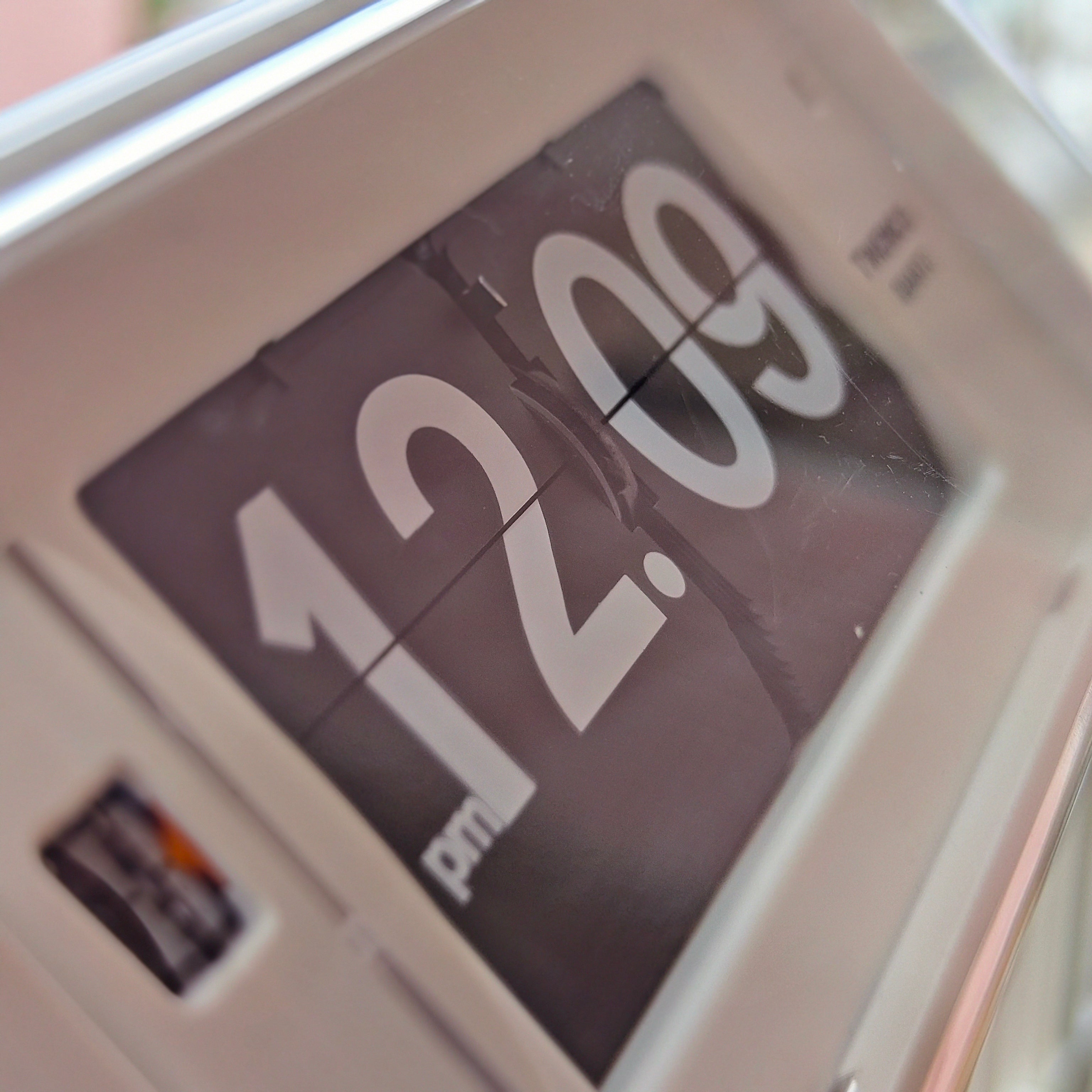
A clock above a sofa can give a living room a clear point of focus without adding another piece of furniture. The difficult part is making it feel connected to the seating below. Too high, and the clock can appear to float near the ceiling; surrounded by equally prominent objects, it can disappear into a busy wall.
Start with the sofa as the visual anchor, decide whether the clock will stand alone or belong to a group, and test the arrangement from the places where people actually see it. The aim is a balanced composition that also works as a time display.
Begin with the sofa, not the entire wall
For a straightforward arrangement, use the centre of the sofa’s back as your starting point. A clock aligned with that centre usually reads as part of the seating area, even when the sofa itself is not centred on the whole wall. A doorway or an empty stretch of wall beside the sofa does not automatically need equal visual treatment.
Look at the sofa and clock together from the entrance to the room. If the clock seems stranded between the sofa and the ceiling, lower the paper template before changing anything else. If it appears squeezed against the back cushions, allow more separation. The useful gap depends on the clock’s outline, the back height and how the wall is used.
For a sectional, begin with the main backrest facing into the room. The chaise may extend the footprint without creating an equally strong vertical line below the clock. Centre the composition over the seating section that visually supports it, then adjust by eye. A sectional does not require the clock to sit above the mathematical centre of its entire floor area.
If you are planning the rest of the room at the same time, our guide to decorating a living room around a statement wall clock covers the broader relationship between the timepiece, furniture and lighting.
Choose one of three compositions
1. A single clock above the sofa
This is the simplest option when the clock has a strong shape, bold numerals or a substantial frame. Let it be the only wall object directly above the sofa, with the lamp, side table and cushions providing interest elsewhere. Empty wall around the clock helps define its outline.
A round dial can provide a useful contrast to a long, rectangular sofa. A horizontal flip clock can echo the sofa’s shape instead. Neither form is automatically better: choose the relationship you want, then keep the surrounding arrangement restrained enough to make it visible.
2. A clock within a small gallery wall
A smaller clock can work with a few prints or photographs when it would feel isolated on its own. Treat the whole group as one composition. The group’s centre can align with the sofa even if the clock sits to one side of it.
Give the clock a clear area around its face. Avoid letting a frame edge, picture ledge or decorative branch overlap the display. Repeat one detail across the group—perhaps black frames, warm wood or a limited colour palette—rather than trying to match every object exactly.
Arrange the pieces on the floor first and use paper shapes to test them on the wall. IKEA’s guide to planning a picture wall explains this template method, including marking the hanging point on each shape. The planning principle also works for a clock: use its actual outline and mounting position rather than guessing from the front.
3. A deliberately off-centre arrangement
An off-centre clock can suit a sofa beside a tall lamp, a window or an existing piece of art. Make the imbalance deliberate. For example, a clock on one side of the wall can relate to a lower framed print on the other, while the full arrangement remains connected to the seating area.
Avoid moving the clock slightly off centre simply to dodge a problem you have not resolved. A small unexplained shift can look accidental. Test a clearly centred version and a clearly asymmetrical version, then choose the one that feels more composed from the room’s main viewpoints.
Judge scale through visual weight
Diameter or width alone does not tell you how prominent a clock will look. A slim, open design can feel lighter than a smaller clock with a deep frame and strong colour contrast. Consider the face, frame and surrounding wall as a whole.
The Thick Frame Series metal wall clock, for example, has a broad frame that gives its outline a distinct presence. That type of design can be styled with fewer nearby objects. A quieter face may benefit from a more defined background or a small supporting group.
Before choosing a larger model, check whether the current clock looks too small or merely too isolated. A better composition may solve the problem without a change of size. For measurements and buying considerations, use our separate wall clock sizing guide. When comparing shapes, the wall clock collection offers a useful view of different dial and display formats.
Connect the clock to the room with one repeated detail
A clock does not need to match the sofa. It can belong to the room through a smaller connection: a frame finish echoed in a lamp, a dial colour picked up in a cushion, or a wood tone related to the side table.
Choose the detail already doing useful work in the room. Adding several new accessories just to justify the clock can make the scheme feel forced. If the sofa is patterned, try a simpler clock face and more open wall around it. If the seating and walls are quiet, the clock can carry more of the colour or shape.
For a flip display, consider its rectangular case as part of the composition, not just the numerals inside it. Our guide to styling a flip clock in a modern interior explores how materials and negative space can connect that form to a contemporary room.
Test readability from the rest of the room
A clock directly above the sofa will often be easier to see from the opposite chair or dining area than from the sofa itself. Decide whose view matters most. If everyone needs to check the time while sitting on that sofa, a side wall may be the more useful location.
Check the view in daylight and with the evening lamps switched on. Look for reflections across a glass face and shadows that hide part of the display. With a flip clock, inspect the actual model from below as well as straight ahead; do not assume a display that reads well at standing height will look the same from a lower chair.
Keep the clock in its intended mounting orientation. A styling problem is a reason to reconsider the position, not to improvise a tilt or alter its mounting hardware.
Make the installation part of the plan
Once the paper layout works, confirm how the clock is designed to hang. Measure the position of the mounting hole or bracket on the back; the fixing point may not be at the top of the case. Leave practical access for removing the clock and changing its battery.
Use the exact model’s instructions and fixings suited to the wall and load. As a manufacturer example, RHYTHM’s wall-clock manual, in its English “Hanging the Clock” section, calls for hardware matched to the mounting point, wall structure and clock’s weight, and warns against hanging the clock tilted. Those instructions belong to that model; check the corresponding requirements for yours.
Before committing to the location, consider people leaning back, raised cushions and any moving headrests. If the clock or its installation cannot stay clear of normal use, choose another part of the wall. The final arrangement should be comfortable to live with as well as pleasing from across the room.
Frequently Asked Questions
Should a clock be centred above a sofa?
Centred over the sofa is a useful starting point for a single clock. In a gallery wall, centre the overall group instead. An asymmetrical arrangement can also work when it has a clear relationship to the surrounding objects.
Can a small clock work above a large sofa?
Yes, particularly as part of a small, coherent group. Test the full arrangement with paper templates. A clock that looks undersized alone may feel balanced beside a few carefully spaced prints.
Does the clock have to match the sofa colour?
No. One connection to the wider room—such as a frame finish or accent colour—is often enough. Keep the clock legible against its background and let the sofa remain a separate material element.
What if I cannot see the clock while sitting on the sofa?
Decide whether it mainly serves people elsewhere in the room. If the sofa is the primary viewing position, try a side or opposite wall where checking the time feels natural.