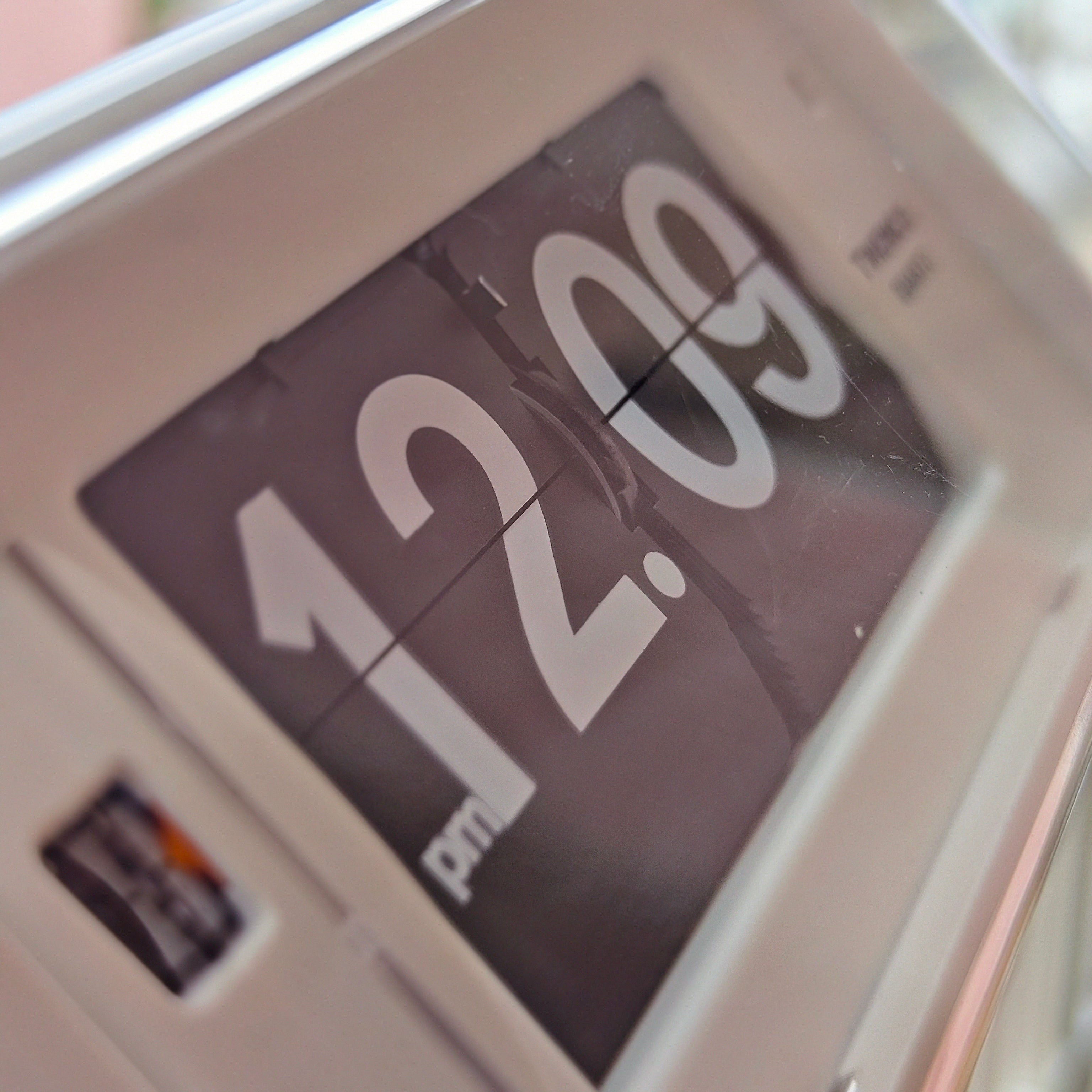
The best clock for a living room is one that remains easy to read from the main seating area and feels correctly scaled to the wall, shelf or furniture around it. In a large room, that may be a substantial wall clock or a physical flip display with real depth. In a compact room, a smaller wall clock or shelf clock can provide the same usefulness without taking over the composition.
Start with the job the clock must do. Should it be a focal point, a quiet background object, a screen-free time display or a practical calendar? Once that role is clear, size, sound, power and placement become much easier to compare.
The best living-room clocks at a glance
| Clock type | Best for | Main trade-off |
|---|---|---|
| Large wall clock | Open rooms and broad, empty walls | Needs careful scale and secure mounting |
| Mechanical flip clock | A visible, kinetic design feature | The card change can be audible |
| Compact wall clock | Small living rooms and secondary walls | May be hard to read from distant seating |
| Silent analogue clock | Calm rooms used for reading or conversation | Less visually animated than a flip clock |
| Table or shelf clock | Renters, built-in shelving and flexible layouts | Requires a clear surface and good sight line |
| Calendar clock | Rooms where date and day information are useful | More visual information can make the display busier |
Begin with the room, not the clock
Match the clock to the available surface
Measure the usable wall or shelf rather than the full room. A clock above a sideboard has to relate to the width and visual weight of that furniture. A clock on a narrow return wall has to fit the wall that actually frames it. The New York Institute of Art and Design distinguishes scale from proportion in interiors: scale concerns the size of an object in relation to the room, while proportion concerns relationships within an object. That is a useful way to judge a clock. Its diameter or case width should feel at home among the surrounding objects, not merely fit between two measurements.
Avoid treating a fixed percentage as a universal rule. Ceiling height, furniture mass, wall colour, clock shape and surrounding negative space all affect how large the clock appears. Make a paper or cardboard template in the clock's listed dimensions and tape it temporarily in position. View it from the sofa, the doorway and any adjoining dining area before buying. For a step-by-step method covering usable wall width, furniture proportion and viewing distance, see our practical wall-clock sizing guide.
If you are deciding between a wall-mounted and surface-mounted format, our guide to wall clocks versus desk clocks explains how room size and viewing distance change the choice.
Test readability from where people sit
Large dimensions do not guarantee a readable clock. Numeral height, contrast, reflections, viewing angle and the amount of information on the face all matter. Stand at the main seat and identify the smallest display you can read comfortably without leaning forward. If the living room is open to a kitchen or dining area, repeat the test from those sight lines.
High-contrast hour-and-minute displays are usually the easiest to scan quickly. A calendar clock can be useful, but smaller day and date cards may need a closer viewing position. A reflective glass front may also produce glare opposite a window or bright lamp, so check the likely light path as well as the wall space.
Decide whether the clock should lead or support
A focal clock deserves breathing room. Give it a clear field rather than surrounding it with several objects of similar visual weight. A supporting clock should repeat something already present in the room—perhaps a black metal frame, warm wood, rounded geometry or a restrained neutral colour—without competing with artwork, a fireplace or a television.
If you already own a statement clock, see our guide to decorating a living room around a statement wall clock. The present guide focuses on choosing the clock first.
Which type of clock works best?
1. A large wall clock for an open room
A large wall clock works best when the room has a broad uninterrupted surface and a long viewing distance. It can fill a visual gap above a low sideboard or on a wall that would otherwise need a group of smaller objects. Choose a simple face when the clock must be read from across the room; extra decoration can reduce clarity even when the overall case is large.
For a modern industrial look, the NeXtime Metal Big Flip clock is a 360 mm-wide stainless-steel model designed for wall or table use. Its 2.2 kg weight makes it a genuine spatial object, so confirm the mounting surface and fixing method rather than treating it like a lightweight print. NeXtime provides a library of model-specific product manuals, including the Big Flip instructions; consult the exact manual before setup or mounting.
2. A mechanical flip clock for movement and character
A physical flip clock adds a brief change of motion every minute. Its card pack, case depth and typography make it feel closer to a small kinetic object than a flat display. It is a strong choice when the clock should animate a shelf or wall without emitting continuous light.
The trade-offs are equally physical: a real flip mechanism requires depth and normally makes a short sound when the card changes. If those qualities are the reason you like it, the format can be rewarding. If you need silence or a very thin profile, consider another type. Our article on mechanical flip clocks versus digital flip displays separates the genuine moving mechanism from screen-based imitations.
The TWEMCO BQ-50 is a more compact statement option at 290 × 145 × 105 mm. It can suit a console, shelf or smaller wall where a very large clock would dominate. For a direct comparison with a calendar-style alternative, see TWEMCO BQ-50 versus Fartech AD-650.
3. A silent analogue clock for a calm shared space
Choose a silent analogue clock when conversation, reading or television takes priority over mechanical theatre. A sweep-style movement can avoid the repeated tick associated with some second hands, while a simple dial keeps the room visually calm. Confirm the exact model's sound description rather than assuming every quartz clock is silent.
The Mobius 2026 Silent Wall Clock is offered in 12.5- and 16-inch sizes, making it easier to match the same design language to different wall areas. A smaller silent metal wall clock can work on a secondary wall or in a tighter seating area where a large focal piece would feel heavy.
4. A shelf or table clock for flexibility
A shelf clock is often the best solution for renters or rooms with awkward walls. It can sit on a bookcase, console or media unit, then move when the furniture layout changes. It also lets you bring the display closer to eye level without making holes in the wall.
Check depth as carefully as width. Leave enough space for the clock's controls and battery door, and make sure books, plants or cabinet doors cannot touch moving cards. A table clock should look intentional within the shelf composition rather than squeezed into the only remaining gap.
5. A calendar clock for practical information
A calendar display suits a living room that also functions as a family hub, work area or entry point. The Fartech AD-650 combines time with day, date and month cards in a 9.5-inch square format. That makes it information-rich rather than physically huge. Place it where the smaller calendar fields can be read, and follow the supplied instructions for date adjustment.
If you prefer to compare wall formats by maker, the Fartech collection, NeXtime collection and TWEMCO wall-clock collection provide useful starting points without mixing in draft or legacy pages.
A practical living-room clock checklist
- Measure the exact position. Record available width, height and shelf depth, not just room dimensions.
- Check the main sight line. Judge the display from the sofa and from any connected spaces where you expect to read it.
- Choose its role. Decide whether it is the focal point, a secondary accent or simply an easy-to-read time display.
- Verify weight and mounting. Use fixings appropriate to the wall construction and the manufacturer's instructions; if unsure, use a qualified installer.
- Check power requirements. Battery-powered clocks offer placement freedom, but battery size, quantity and replacement access vary.
- Think about sound. A mechanical flip, ticking second hand and silent sweep create very different rooms.
- Look for glare. Test the proposed position at the brightest time of day.
- Use listed dimensions. Product photographs can make compact clocks look monumental and large clocks look deceptively manageable.
So, what is the best clock for your living room?
For a large open room, begin with a clearly legible wall clock or substantial flip clock that can hold its own at a distance. For a medium room, a compact statement clock such as the BQ-50 can add movement without consuming the wall. For a small room or rental, use a shelf clock or a modest silent wall clock. Choose a calendar clock when day and date information are genuinely useful, not simply because a busier display looks impressive online.
The right clock is the one that solves the room's real problem: an empty wall, a weak sight line, a need for ambient time or a desire for one memorable object. If the product's scale, display, sound and mounting all suit that role, style becomes a pleasure rather than a compromise.
Frequently Asked Questions
What size clock is best for a living room?
There is no universal diameter. Measure the usable wall or shelf, consider nearby furniture and test a full-size paper template from the main seating position. A longer viewing distance generally calls for larger, higher-contrast numerals.
Where should a clock go in a living room?
Place it where it can be read from the main seats without glare or obstruction. Above a sideboard, on a clear feature wall or on open shelving can work well, provided the clock does not compete with the room's existing focal point.
Are flip clocks good for living rooms?
Yes. Their visible movement and non-glowing cards suit living rooms particularly well. Check the clock's depth, sound, power requirements and viewing distance before choosing a model.
Should a living-room clock be silent?
Only if the room's use requires it. A quiet reading or television room may benefit from a silent movement. In a social space, a brief flip sound may be unobtrusive or even part of the clock's character.