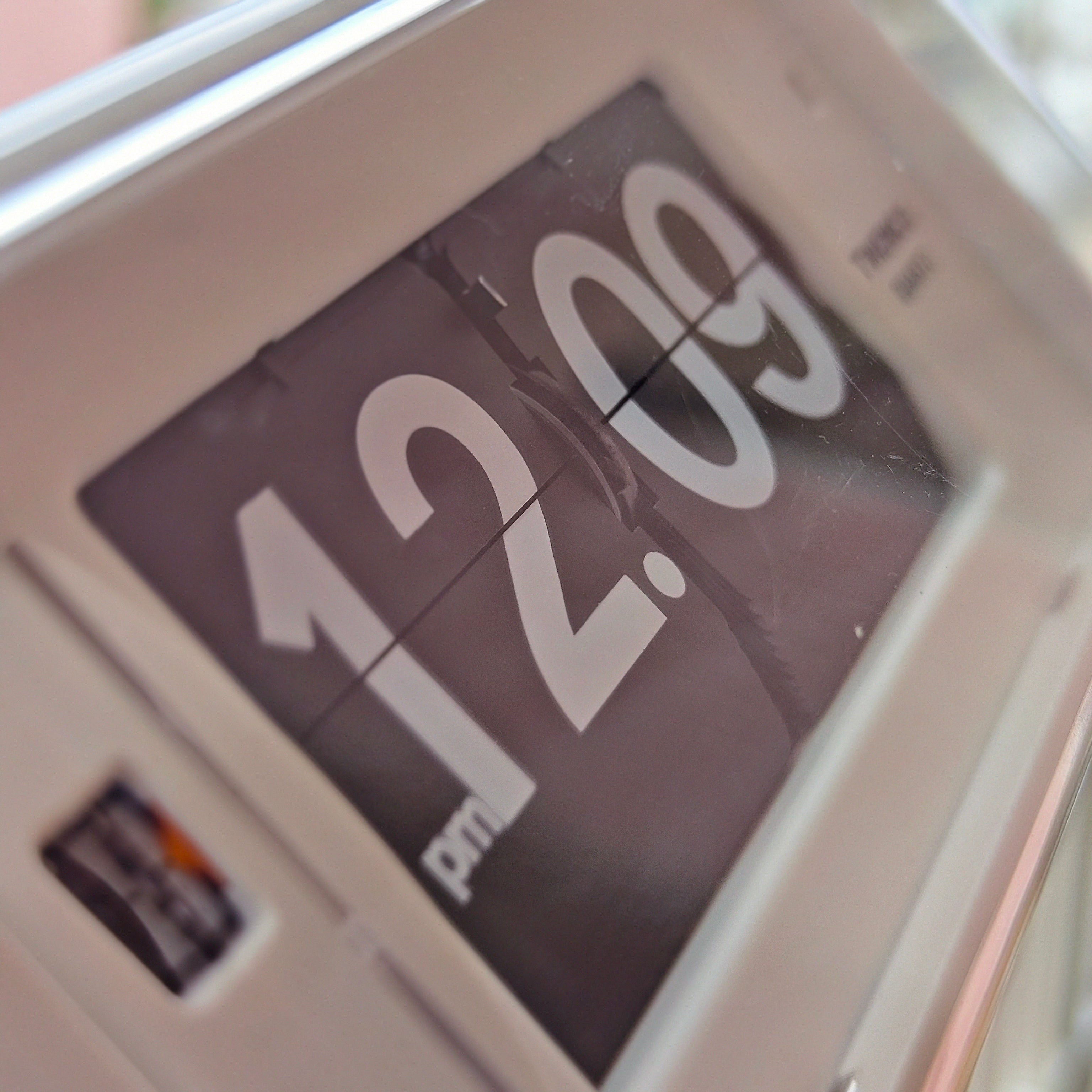
A mechanical flip clock is worth paying more for when the physical movement, depth and sound are part of what you want to own. A low-cost digital flip display is the better value when you mainly want the visual style, quiet operation, a compact case or extra functions.
Both can show the same large flipping numerals, but they do not deliver the same object. One moves printed cards. The other redraws pixels or illuminated segments to imitate the transition. The useful question is not which technology is universally better; it is whether you want the flip to be a real mechanism or simply an interface.
Mechanical flip clock vs digital flip display at a glance
| Buying factor | Mechanical flip clock | Low-cost digital flip display |
|---|---|---|
| Display | Physical printed cards or leaves | LCD, LED or another electronic screen |
| Movement | Cards physically release and fall into view | Pixels change or animate a flip effect |
| Sound | Usually an audible click or flap | Normally silent when the minute changes |
| Visual character | Three-dimensional, kinetic and object-like | Flat, clean and often more visually neutral |
| Features | Usually focused on time, sometimes date or alarm | Can add alarms, brightness, temperature and timers cheaply |
| Space | Needs depth for the card pack and mechanism | Can be thinner and lighter |
| Typical reason to buy | You value the mechanism and design experience | You value function, convenience or the flip-style graphic |
If you first need a technical definition of each format, read our guide to mechanical versus digital flip clocks. This article goes one step further: it asks whether the physical mechanism justifies the price difference for your needs.
What are you actually paying for in a mechanical flip clock?
A real moving display
A physical flip display needs more than a clock circuit and a printed case. The cards must be supported, advanced and released in the correct sequence. A larger split-flap display patent illustrates the underlying family of parts: a housing, drive, gearbox, rotor shaft, rollers and multiple flaps. A home clock may use a simpler arrangement, but the essential difference remains—information is carried on moving pieces rather than drawn on a screen.
That construction produces qualities a screen cannot fully copy. The cards have thickness. Their edges catch the light. The upper and lower halves sit on different planes, and the minute change briefly alters the object. The motion is not a transition effect added to the interface; it is the display doing its job.
If the mechanism itself interests you, our explanation of how a mechanical flip clock works follows the movement from motor to card release.
Casework, alignment and assembly
Physical cards need clearance to move without rubbing. Shafts, supports and release points must stay aligned, while the case has to protect the display without hiding it. Larger cards also require a larger structure. These factors can add material, assembly and quality-control costs compared with putting a flip animation on an existing screen platform.
None of this proves that every mechanical clock is well made. A loose frame, poorly printed cards or inconsistent alignment can undermine the experience. The price is justified only when the construction is visibly and functionally sound. Our guide to why flip clocks can be expensive explains how mechanism, materials, production scale and support contribute to cost.
Where a digital flip display offers better value
More functions in less space
A screen can display time, date, alarms, temperature, countdowns or different layouts without adding a new drum of cards for every function. It can also fit into a thin case and remain easy to read at night when illuminated or backlit.
For a bedside table, travel bag or compact desk, those advantages may matter more than physical movement. A digital display can change silently, and adjustable brightness may be more useful than the ambient, non-glowing character of printed cards.
The MUJI Minimal Digital Desk Clock illustrates the practical side of the category: a compact LCD format with time, date and timer functions. It is not pretending to be a mechanical object; its value comes from clarity and utility.
The flip look without the mechanical commitment
Some buyers simply like the typography and animation. A digital flip-style clock can provide that visual language without exposed cards, minute-by-minute sound or the depth of a card pack. That is a legitimate choice, especially when the clock should blend into the room rather than become a focal point.
Low price does not automatically mean poor value. It may reflect a simpler case, a mass-produced screen module and fewer mechanical components. Likewise, a higher price does not automatically prove better quality. Compare what each product actually offers rather than treating the technologies as status levels.
Five differences that matter in daily ownership
1. Visual depth and design presence
A mechanical flip clock is usually more noticeable as an object. An open model such as the MIDCLOCK Home Decor Flip Clock makes the card pack and mechanism part of the composition. An enclosed model such as the NeXtime Modern Table & Wall Flip Clock keeps the same physical action inside a compact case.
A screen is flatter and can be more discreet. That is useful when you want information without a strong decorative statement. Decide whether the clock should anchor the shelf or quietly occupy it.
2. Sound
A real card release normally makes a short sound. Its volume depends on the mechanism, card material, case and room acoustics. Some people enjoy that audible marker of time; others find it distracting. Our article on why flip clocks click explains the source of the sound.
A digital animation normally changes silently. If the clock is for a bedroom, recording space or extremely quiet study, that may be the decisive advantage.
3. Readability and light
Printed cards rely on ambient light. In a bright room, high-contrast numerals can be calm and easy to scan without adding another glowing surface. In darkness, they may be unreadable unless the clock has a separate light.
Digital displays vary. An LED display emits light; an LCD may be reflective, backlit or always illuminated. Do not assume that every digital clock is bright or every mechanical one is easy to read. Check numeral size, contrast, viewing angle and night-time behaviour for the exact model.
4. Maintenance and repairability
A mechanical display has moving cards and alignment points that can be affected by dust, rough handling, weak batteries or obstruction. A digital clock has fewer display parts to move, but buttons, screens, backlights and sealed electronics can still fail.
Repairability depends on the product, not merely the category. Look for a model number, manual, warranty and parts route. NeXtime’s page of product-specific clock manuals shows the kind of documentation that helps owners set up and identify a clock correctly. For a wider ownership view, see our guide to flip-clock lifespan and maintenance.
5. Accuracy
The display format does not determine the quality of the time base. A mechanical flip clock can use quartz timing, while a digital display can use a quartz circuit of its own. The NIST timekeeping FAQ explains that frequency error translates into time error; the relevant issue is the oscillator and regulation, not whether the result appears on cards or pixels.
A physical display adds one more visible step: the correct card must release at the intended moment. Therefore, compare stated accuracy and display behaviour separately.
How to tell whether a listing shows a real flip mechanism
- Look for card edges. Product photographs should reveal separate leaves, a centre split or a card pack.
- Read the mechanism description. Useful terms include physical cards, moving leaves, split-flap or flip-card mechanism.
- Check the side view. A real mechanism needs depth; a very thin product is more likely to use a screen.
- Check the power and setting instructions. A credible listing should state the battery or power source and explain how the clock is adjusted.
- Do not rely on “mechanical” alone. Sellers sometimes use the word loosely to describe a style. Look for evidence of actual moving cards.
- Watch for screen clues. Brightness controls, multiple themes, seconds animations or a large range of display modes usually indicate an electronic screen.
Which one is worth buying?
Choose a mechanical flip clock if the card movement is the point: you want a tactile object, enjoy the brief sound, have room for its depth and expect the clock to contribute to the interior. The Craftsman’s Choice collection includes accessible physical designs, while the TWEMCO flip clock collection covers more established table, wall and calendar formats.
Choose a digital flip display if you want the graphic style at a lower price, need silent operation, prefer a compact case or value alarms, backlighting and extra information. It may be the more rational purchase even if a mechanical clock is the more distinctive object.
If you remain undecided, use one test: if the flip animation disappeared tomorrow, would you still want the product? If the answer is yes because its functions and size suit you, choose digital. If the answer is no because the real motion is exactly what attracts you, choose mechanical. Our broader guide to whether flip clocks are worth it can help you weigh that experience against sound, space, maintenance and price.
Frequently Asked Questions
Is a digital flip clock a real flip clock?
It uses a flip-style visual, but the display does not physically flip. A screen changes pixels or segments to imitate the movement. Whether it counts for you depends on whether you want the appearance or the mechanism.
Are mechanical flip clocks always expensive?
No. Prices vary with size, materials, construction, brand and support. Affordable physical flip clocks exist, but confirm that the listing shows genuine moving cards and provides clear specifications.
Are digital flip displays more accurate?
Not automatically. Accuracy depends on the clock’s timekeeping circuit and operating conditions. A mechanical flip clock may use quartz timing just as a digital clock does, although its cards must also release correctly.
Which type is better for a bedroom?
A digital display is usually the safer choice for a light sleeper because its minute change can be silent and it may offer adjustable night-time visibility. A mechanical model may suit someone who prefers a non-glowing display and is comfortable with the flip sound.