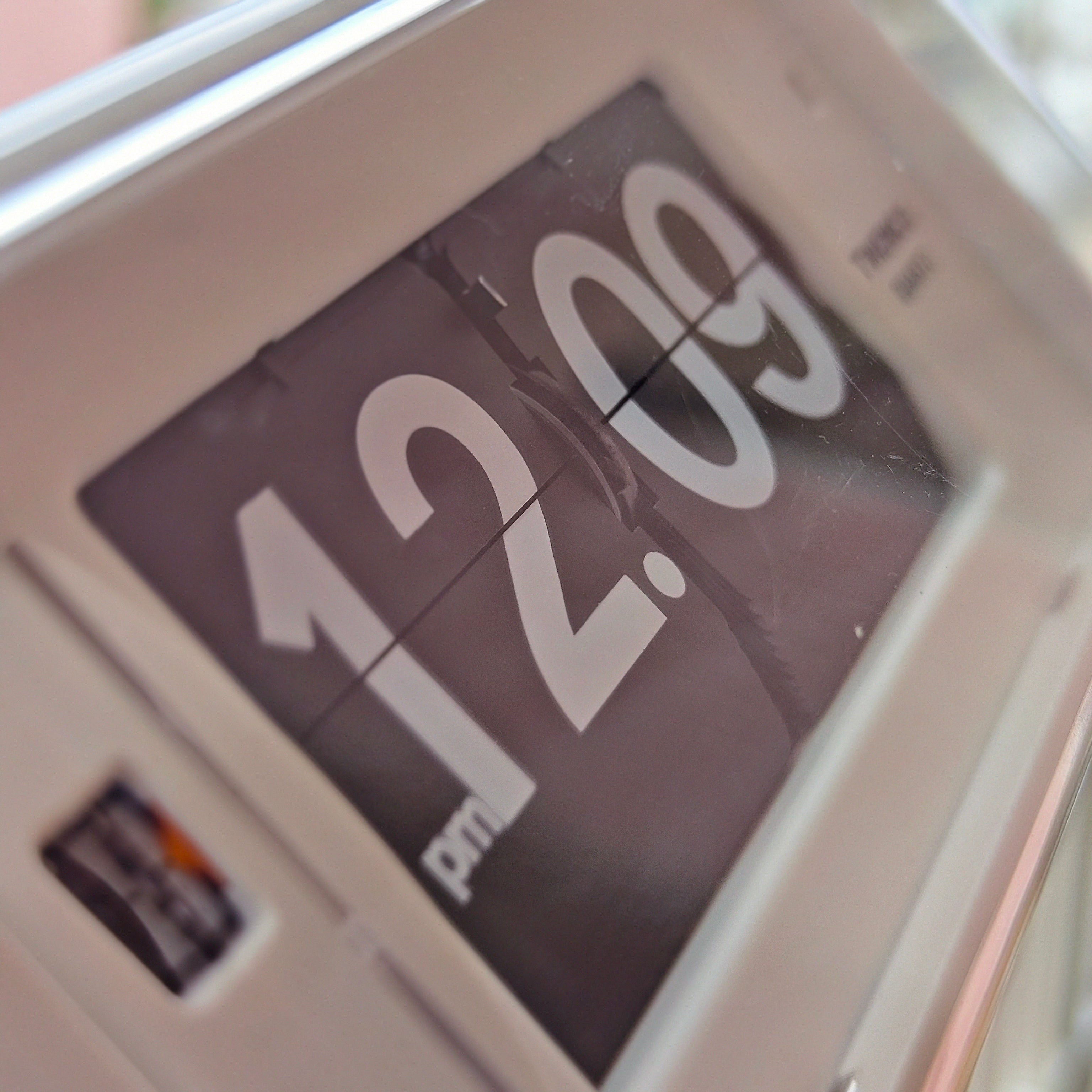
Flip clocks often cost more than ordinary quartz clocks because the display is a physical mechanism, not simply a pair of hands or a screen. A genuine flip clock needs printed cards, drums or supports, shafts, gears, a motor, a release sequence and a frame that keeps everything aligned. Those parts must be made, assembled and tested as a system. When production volumes are modest, the design and tooling costs are also divided across fewer units.
That does not mean every expensive flip clock is good, or that every affordable one is disposable. Price can reflect construction, scale, materials, design authorship, brand support, distribution and scarcity in very different proportions. The useful question is not only “Why is this clock expensive?” but “What am I receiving for the difference?”
1. A physical display needs more parts
A basic quartz wall clock can use a mass-produced movement to turn three lightweight hands. A screen-based clock can change its digits electronically. A mechanical flip display has to move a set of physical cards in the correct order while keeping the visible halves aligned.
A split-flap technical design typically includes a housing, drive, gearbox, rotor shaft, receiving rollers and multiple flaps. You can see that component logic in this split-flap display patent. A domestic clock is smaller and may use a different layout, but the cost principle is the same: the visual effect depends on interacting mechanical pieces.
Each extra interface creates another tolerance to control. Cards must clear one another without excessive play. Shafts must remain straight. The motor needs enough torque to advance the display without being needlessly power-hungry. The case must support the mechanism in its intended wall or table orientation. Our guide to how a mechanical flip clock works explains that sequence in more detail.
This is also why a real flip clock should not be confused with a digital display that imitates the animation. The two can share a visual language while having very different parts, production processes and ownership needs. See our comparison of mechanical and digital flip clocks if you are deciding which experience you actually want.
2. Tooling and development have to be recovered
Before the first sellable clock exists, someone has to design the mechanism and case, make prototypes, create printing artwork, specify materials, build or commission tooling, and test how the parts behave together. Some of those costs are fixed: they are incurred whether a maker produces a small batch or a much larger run.
The economics are straightforward. The OpenStax explanation of fixed and variable costs notes that machinery, equipment, research and development can be fixed costs, and that average cost is high at low output because those costs are spread over fewer units. Flip clocks are a relatively specialised category, so a maker may not achieve the enormous volumes behind a generic clock movement or commodity LCD module.
Tooling is not the whole retail price, and it should not be used as a vague excuse for any price. It is simply one reason that two products with similar dimensions can have different economics. A case built around a common mechanism, limited colour palette and standard parts may cost less to launch than a new enclosure, custom cards and a newly engineered display.
3. Assembly and testing are part of the product
A pile of accurate components is not yet a reliable clock. The card packs have to be loaded in sequence, gears and shafts fitted, controls checked, and the display observed through repeated changes. A fault that is almost invisible at one minute may appear when the hour changes or when a calendar row advances.
More manual handling usually means more labour per clock. Quality control also adds time, but it can prevent tilted cards, rubbing, missed flips, damaged printing or a mechanism that only works in one orientation. Buyers rarely see this work, because successful assembly is most noticeable when nothing goes wrong.
There is a sensible limit. “Hand assembled” is not automatically superior, and a well-designed automated process can be extremely consistent. What matters is whether the finished clock is aligned, stable and supported by realistic specifications and instructions.
4. Size and materials change the cost quickly
A larger flip clock is not merely a small model scaled up on a computer. Bigger cards need a wider, stiffer frame and may require more torque. A wall-mounted case needs secure fixing points. Shipping volume, protective packaging and damage risk increase as the product grows.
Materials matter too. An open ABS clock, a compact moulded case and a large stainless-steel clock solve different design problems. The MIDCLOCK Home Decor Flip Clock, for example, uses an open ABS construction and is listed in a lower price band. The larger NeXtime Metal Big Flip clock uses a stainless-steel case, weighs 2.2 kg and is designed for table or wall use. Its higher price is not explained by the timekeeping function alone; scale, enclosure, weight and presentation are part of the object.
Finish quality can add further work. Consistent printing, clean edges, colour matching and a case that does not twist may be more valuable than a decorative feature that looks impressive in a photograph but adds little to daily use.
5. Design has value beyond the bill of materials
A clock is always visible. Buyers therefore pay for proportion, typography, colour, sound, motion and the way the object occupies a room—not only for its motor and plastic weight. A successful design makes the mechanism legible without becoming visually busy, and turns the minute change into part of the atmosphere.
Original design work includes decisions that are difficult to price from a specification sheet: the speed and sound of the flip, the spacing around the numerals, how the clock reads from across a room, and whether its controls interrupt the form. Brand heritage or a recognised designer can increase the price further, but the premium is meaningful only if those qualities matter to you.
There is no need to treat design as a luxury label. An affordable clock can be thoughtful and enjoyable. Conversely, a famous name cannot compensate for poor fit, unclear specifications or a product that is wrong for the room.
6. Support, documentation and distribution add real costs
Packaging, warehousing, retailer margins, payment fees, international freight, warranty handling and customer support sit between the factory and the buyer. Products sold through a responsible channel also need accurate descriptions and a way to resolve defects or shipping damage.
Documentation is a small but useful signal. NeXtime maintains a page of model-specific clock manuals, allowing owners to check setup and battery instructions. A clear model number, manual, warranty and contact route do not guarantee longevity, but they make correct use and future support more likely.
Repairability matters as well. A clock that can be identified, diagnosed and serviced may offer better long-term value than a cheaper anonymous model that becomes uneconomical to repair. Our guide to flip-clock lifespan and maintenance explains why parts support and construction can matter more than a bold durability claim.
7. Vintage prices follow different rules
A vintage flip clock is priced as both a machine and a collectible object. Condition, originality, rarity, maker, colour, documented servicing and regional power requirements can matter more than manufacturing cost. A model that was ordinary when new may become expensive because clean examples are scarce.
Scarcity does not remove risk. Old wiring, motors, lubricants, plastics and cards may have deteriorated. A cosmetically perfect clock can still need specialist work, while a repaired example may be more practical but less original. Treat the asking price as the start of an assessment, not proof of value.
What should you check before paying more?
- Is it a physical flip mechanism? Confirm whether the cards move or a screen simulates the effect. Our comparison of mechanical flip clocks and digital flip displays explains how the two formats differ in construction, ownership and value.
- Are dimensions and weight published? Large clocks have different mounting, shipping and spatial requirements.
- Are the materials described precisely? Look for named case and card materials rather than broad words such as “premium”.
- Is there a manual and a model number? These make setup, battery choice and support easier.
- Are accuracy and operating figures model-specific? Useful specifications are better evidence than lifestyle copy.
- What does the warranty cover? Check the seller’s actual terms and the process for damage or defects.
- Can you live with the sound? The flip is part of the appeal, but it may not suit a very quiet bedroom.
- Is the premium visible to you? Pay more for the material, scale, design or support you value—not for a label you do not.
Price bands can still be useful once you know what changes between them. Our flip-clock budget guide compares options under $100, $200 and $500, while the Craftsman’s Choice collection brings together design-led clocks at more accessible price points.
When is an expensive flip clock worth it?
A higher-priced flip clock can be worth buying when the premium pays for something you will notice for years: a clearer and larger display, better case construction, distinctive industrial design, published specifications, dependable support or a model with genuine collectible significance.
It is less convincing when the listing hides basic information, relies on invented heritage, uses “mechanical” loosely, or charges mainly for styling that can be found in a better documented clock. Compare exact products rather than assuming a price tier. A compact TWEMCO QT-30 and a large metal NeXtime model have different materials, dimensions and design roles; neither is simply a more expensive version of the other.
The best value is the clock whose construction and experience match its use. For a desk, that may be a compact, readable model with simple controls. For a living room or studio, scale and case material may justify more. For a collector, originality and condition can outweigh everyday convenience. Our guide to whether flip clocks are worth it helps match those trade-offs to different buyer types.
Frequently Asked Questions
Why do flip clocks cost more than digital clocks?
A real flip clock needs a motor, gears, shafts, supports and many printed cards that must move in sequence. A digital clock can change a screen electronically, so it may use fewer display parts and benefit from much larger production volumes.
Does a more expensive flip clock last longer?
Not automatically. Better alignment, materials, documentation, warranty and parts support can improve long-term value, but price alone proves none of them. Check the exact model and seller support.
Are metal flip clocks better than plastic ones?
Metal can provide rigidity, weight and a particular finish, but it also increases cost and shipping weight. A well-engineered plastic case can be durable and easier to place. Choose by construction quality and use, not material prestige alone.
Are vintage flip clocks expensive because they are better?
Often their price reflects rarity, condition, originality and collector demand rather than everyday performance. A vintage clock may be beautifully made, but it can also need voltage conversion, specialist repair or hard-to-find parts.
How much should I spend on a flip clock?
Spend enough to get the mechanism, size, materials and support you need. Compare model-specific specifications within your budget, then decide whether a design or collector premium is personally worthwhile.