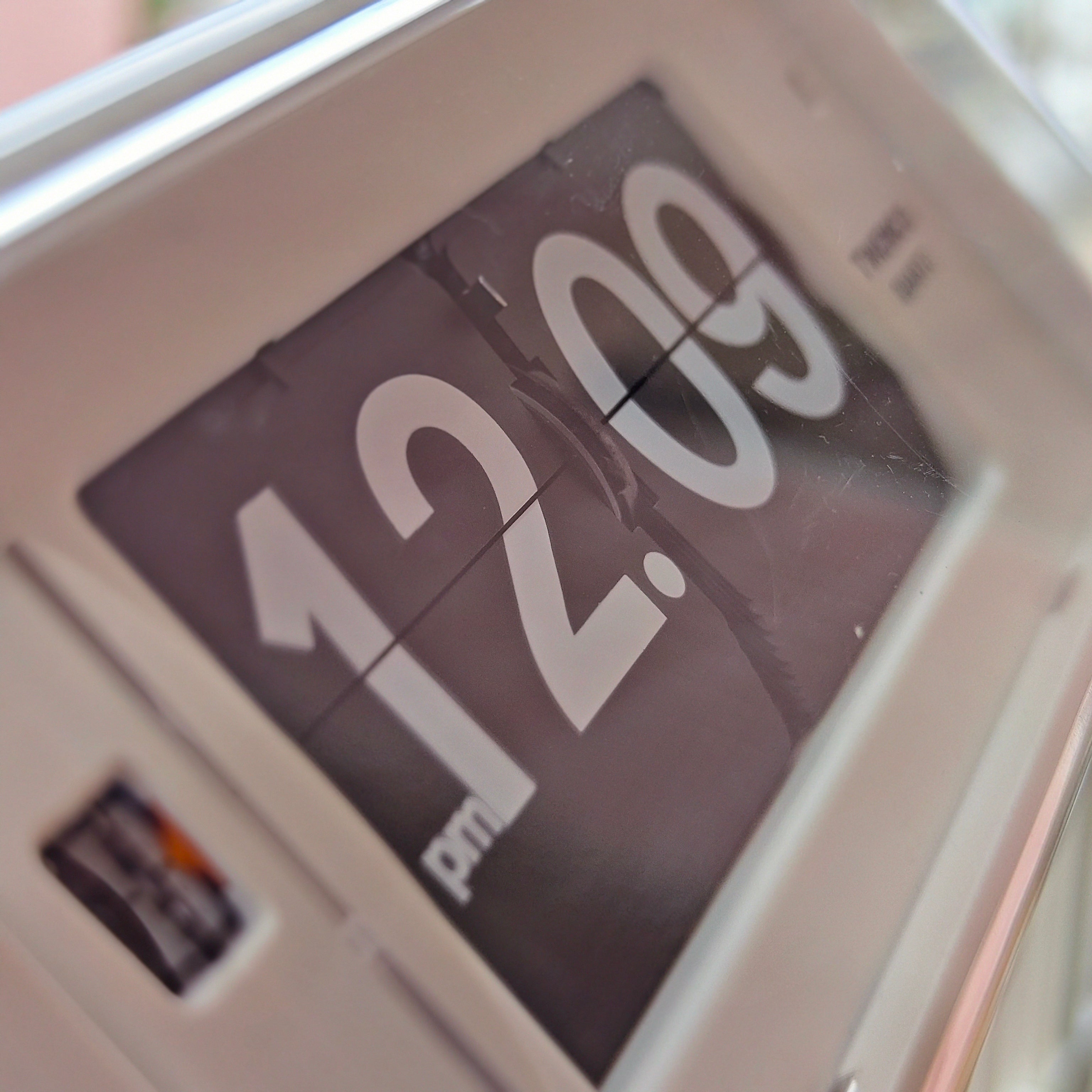
On a clear wall, start with the centre of the clock face at the eye level of the person who will read it most often. Measure that height from the floor in the normal viewing position. If the clock serves people seated at a dining table, use a seated sightline; if it is mainly for someone walking through the hall, start with a standing sightline. Above a sofa or console, also check how the clock relates to the furniture and whether the display can be read from elsewhere in the room.
The number you choose is the height of the face centre, not the height of the hook. That distinction makes it much easier to compare positions before making a hole.
Find the height your room actually needs
Stand or sit where you normally expect to check the time. Look towards the intended wall without lifting your chin, then have someone hold a piece of paper around that level. If you are working alone, measure your eye height in that position and transfer it to the wall with a tape measure. Try the clock outline there first, then move it up or down in small increments.
If you need a neutral starting point for an open wall, about 147 cm (58 inches) to the centre is one height you can test. The Delaware Art Museum’s exhibition team uses a 58-inch centre for many two-dimensional works. That is a gallery example, not a clock standard. It is most useful when the wall is clear and the clock will usually be read standing. A seated reading position or a tall piece of furniture can give you a better reference.
When the clock has a calendar or a face placed off centre, think about what you actually read. If the time is on one part of the display and the date on another, test both. A clock can look balanced on the wall while the smaller information is hard to see.
Use the furniture to check the lower edge
Above furniture, take a second measurement: the gap between the bottom of the clock and the top of the object below it. The centre measurement tells you how high the clock sits in relation to the viewer; the gap tells you whether it feels connected to the room. Two clocks with the same centre height can have very different gaps.
Suppose the sofa back is 90 cm high. A 40 cm round clock centred at 148 cm has a bottom edge at 128 cm, leaving 38 cm above the sofa back. A 60 cm clock at the same centre height leaves 28 cm. Neither gap is a target. The example shows why you should measure to the edge of the actual clock instead of copying someone else’s centre height.
With a sofa, check where heads and moving headrests can reach. With a console, allow for objects you really keep there, like a lamp or a vase. If the only position that clears the furniture also puts the clock beyond comfortable view, try another wall or a different case shape. Our guides to placing a clock above a sofa and choosing a clock size for a sofa wall cover the layout and proportion decisions in more detail.
Start from a different viewing position in each room
Living and dining rooms
A clock over the sofa may be intended for the person coming through the door, someone in an opposite chair, or someone in the adjoining kitchen. Pick the most frequent viewing spot and check the others second. If the sofa itself is where people want to read the clock, a side or opposite wall will usually offer a more natural view than the wall directly behind them. In a dining room, check the view from an actual chair with the usual table settings in place.
Kitchens and hallways
Begin with a standing view and then walk your usual route. In a kitchen, an open cabinet door, an extractor hood or a tall appliance may block the face from one side. In a hallway, people may first see the clock at an angle. Test it from the entry point as well as directly in front. A slight shift sideways may improve the view more than mounting higher.
Home offices and bedrooms
In a home office, start at the desk chair with the monitor in its normal position. A clock high above the screen might be visible while standing but awkward to check during work. In a bedroom, decide whether the clock is mainly for the doorway, a dressing area or the bed. Try the sightline you actually use before committing to a centred arrangement.
Check readability at the proposed height
Distance changes what you can read. From an adjoining room, fine hands or small numerals may be difficult to distinguish even if the case itself looks substantial. If a display looks small at the real viewing distance, compare a simpler face or a more direct viewing location before moving it higher. Use the Wall Clocks collection to compare dial and case shapes when deciding what to test.
Depth deserves a separate check. For example, the TWEMCO BQ-50 flip clock is listed at 290 × 145 × 105 mm. A paper rectangle represents its front outline, but it cannot show how a deep case looks from below. For a recessed or glazed display, check the actual clock, if you have it, from the primary seat and under your evening lighting. If the display is partly obscured or catches a reflection, test a different position rather than improvising a tilt.
Translate the face height into a fixing point
- Mark the chosen face centre on the paper outline and position the template at that height.
- Measure the vertical offset from the actual face centre to the point where the clock engages its hanger. Transfer that offset to the template. On a clock with several mounting points, use its mounting instructions or template.
- Check the proposed fixing point against the wall and the clock’s instructions before drilling. The RHYTHM wall clock manual’s hanging section, for example, calls for upright mounting and a hook suited to the clock and wall. Follow the instructions for your own exact model.
For a simple single hanger, if the face centre is 148 cm above the floor and the engagement point is 12 cm above that centre, the engagement point should be at 160 cm. If you use a hook whose support point is lower than its fastener, account for that separate offset too. Do one last seated or standing check before making any permanent marks.
Frequently Asked Questions
Is 150 cm a good height for a wall clock?
It can be a useful trial height to the centre of the face on a clear wall. Test it from the position where people actually check the time. Over tall furniture, or for a predominantly seated view, a different height may be easier to live with.
Should the clock sit higher in a room with tall ceilings?
Only if the higher position still reads comfortably. Try it from the main chair or doorway first. A tall ceiling creates more wall space, but the viewer’s eye height stays where it is.
Should I measure to the top of the clock or the centre?
Use the face centre when comparing viewing heights and the bottom edge when checking furniture clearance. Measure the fixing point separately from the back of the clock or its mounting template.