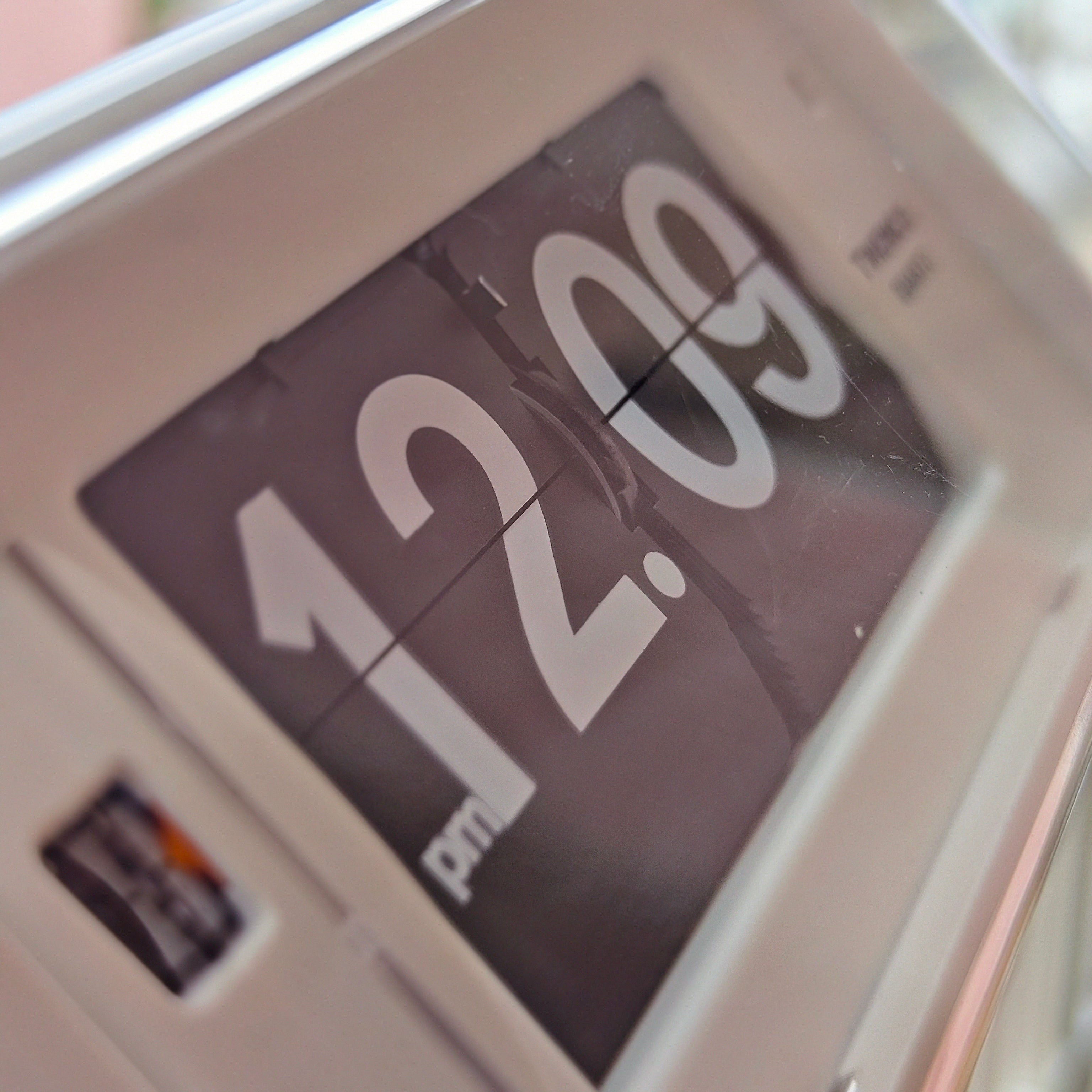
Flip clocks look mechanical because time is revealed by moving cards, but the visible flip is only one part of the system. In many modern models, a quartz movement keeps time while a motor and card mechanism translate that timing into a physical display. That distinction matters: a clock can keep accurate time yet show a late or incomplete flip, or it can flip cleanly while gradually running fast or slow.
So, how accurate are flip clocks? There is no single figure that applies to every model. The useful answer is the manufacturer’s accuracy specification, normally expressed as seconds gained or lost per month under stated temperature conditions. As current examples, the TWEMCO BQ-38 calendar flip clock is specified at 1.5 seconds per month between 20°C and 25°C, while the TWEMCO BQ-50 retro flip clock is specified at 3 seconds per month over the same temperature range. Those are model-specific figures, not a promise for all flip clocks.
What “accuracy” means for a flip clock
Clock accuracy is the difference between the time a clock reports and a reliable reference time. If a clock is set correctly today and reads 12 seconds fast after 30 days, its observed drift is approximately +12 seconds per month. A negative figure means it has lost time.
That rate is easier to understand when converted to a longer period. A specification of 1.5 seconds per month is roughly 18 seconds per year; 3 seconds per month is roughly 36 seconds per year. These are simple projections. Real performance can vary because temperature, component tolerances, age and operating conditions are not perfectly constant.
Accuracy is also different from precision. A clock may gain almost the same amount each month, making its behaviour predictable, without agreeing exactly with reference time. Consistent drift is generally easier to assess than erratic jumps.
The timekeeper and the display do different jobs
A modern flip clock typically combines two systems:
- The timebase establishes the pace of time. Many current battery-powered clocks use a quartz oscillator and electronic divider.
- The display mechanism advances the printed cards at the required interval.
The U.S. National Institute of Standards and Technology explains that a quartz clock commonly uses a crystal oscillating at 32,768 Hz; circuitry divides that frequency down to produce one-second ticks. Its timekeeping and clocks guide also shows why a small frequency error accumulates into a measurable time error.
The motor, gears and cards then turn those timing signals into motion. Our guide to how a mechanical flip clock works looks more closely at that physical sequence. The important point for accuracy is that the oscillator can be behaving normally even when the display hesitates.
Time drift, display lag and card problems are not the same
Timekeeping drift
True drift develops progressively. The clock may be two seconds fast after a week, four seconds fast after two weeks and about eight seconds fast after a month. The direction and rate are reasonably consistent. That pattern points towards the timebase rather than the cards.
Display lag
A flip display may change slightly after the reference minute begins because the mechanism needs time to release and move a card. A small, repeatable transition delay is not equivalent to losing that amount every minute. Measure the clock only after the card has completed its movement.
Sticking, skipping or misalignment
A card that catches, a wheel that does not advance fully or a display that sits between numerals is a mechanical display fault. The next flip may correct it, or the error may suddenly become a full minute. This looks very different from a smooth accumulation of seconds. Dust, incorrect orientation, wear or a weakening power supply may be involved; do not force the cards by hand unless the maker’s instructions explicitly allow it.
Setup and power interruptions
An incorrectly set AM/PM cycle, a recent battery change or a brief loss of power can create an immediate offset. That is a setup event, not evidence of the clock’s normal monthly accuracy. Reset the clock, record the starting point and observe it again before drawing a conclusion. If the timing remains wrong, use our step-by-step guide to diagnosing a flip clock that flips at the wrong time.
What affects flip-clock accuracy?
Quartz tolerance
No quartz crystal oscillates at its nominal frequency with zero error. Manufacturing tolerance creates a small frequency difference, and that difference becomes accumulated gain or loss. This is why two clocks of the same general type can perform differently and why a model specification is more informative than a broad claim about “quartz accuracy.” For a closer explanation of the electronic principle, read our guide to how quartz clocks keep time.
Temperature
Quartz frequency changes with temperature. Manufacturers therefore often state accuracy within a reference band. TWEMCO’s BQ-38 and BQ-50 figures, for example, are specified between 20°C and 25°C, while their stated operating range is broader. A clock can continue to operate outside the reference band without necessarily meeting the tighter room-temperature accuracy figure.
For the cleanest test, keep the clock away from direct sun, radiators, air-conditioning outlets and other places with large temperature swings.
Age and component condition
Electronic components and the mechanical display both age. Our guide to how long flip clocks last examines the movements, cards, contacts and environmental factors that can limit their useful life. A gradual, stable change in rate may be associated with the timebase; intermittent jumps, laboured flips or missed minutes more often suggest a display, drive or power problem. Vintage clocks deserve especially cautious diagnosis because previous repairs, lubrication and replacement parts can all affect behaviour.
Battery condition and contact
A weak battery is more likely to produce unreliable operation, weak motor action or a stopped clock than a neat, repeatable quartz drift rate. Corroded or loose contacts can also create intermittent faults. Use the battery type specified for the model, check polarity and replace an old cell before assessing accuracy. Our article on battery efficiency in analog clocks explains why battery life and timekeeping accuracy should be considered separately.
How to test your flip clock accurately
- Choose a trustworthy reference. Use a network-synchronised device or an official time service such as NIST’s official U.S. time display. Allow for network and device delays when making very fine comparisons.
- Install a fresh, correct battery if condition is uncertain. Clean only accessible contacts according to the maker’s guidance.
- Set the clock carefully. Wait for the flip to finish, then record the starting difference rather than assuming it is exactly zero.
- Keep the clock in normal use. Place it in its intended orientation on a stable surface or secure wall mounting, away from extreme heat and cold.
- Compare at the same time each week. Record the signed error: “+” for fast and “−” for slow.
- Continue for 30 days. A monthly test separates steady drift from one-off setup errors and makes comparison with a manufacturer’s seconds-per-month specification straightforward.
For example, if the clock starts at +1 second and reads +10 seconds after 30 days, its observed drift over the test is about +9 seconds per month—not +10. If the result changes from +3 seconds to −20 seconds and then jumps by a minute, investigate the display and power system rather than treating the numbers as a stable rate.
When is a flip clock inaccurate enough to need attention?
Start with the published specification for the exact model. A reading inside that tolerance under the stated conditions is normal, even if it does not match a phone to the second after several months. If no specification is available, a 30-day measurement gives you a useful baseline without inventing a universal standard.
Take action when the measured rate is consistently outside the model’s specification, when drift changes sharply, or when the cards skip, stick or fail to settle. Begin with the least invasive steps: confirm the settings, replace the battery, verify placement and observe again. For a symptom-by-symptom checklist, see our guide to common flip-clock problems and safe first fixes. For dust and routine care, follow the conservative approach in our flip-clock cleaning and maintenance guide. Internal repair is better left to a qualified technician when the clock is valuable, mains-powered or unfamiliar.
Choosing accuracy without losing the flip-clock character
Accuracy is a model attribute, not a visual category. A physical flip display does not automatically make a clock inaccurate, just as a digital-looking display does not guarantee a better timebase. Our comparison of mechanical and digital flip clocks separates display format from the technology that keeps time.
When comparing models, look for a stated accuracy figure, the conditions attached to it, the correct battery type and the intended operating temperature. The TWEMCO flip-clock collection, for instance, includes models with different specifications despite their shared design language. That makes the individual product page—not a brand-wide assumption—the right place to check.
Frequently Asked Questions
Do flip clocks lose time?
Any non-synchronised clock can gain or lose time. A modern quartz-driven flip clock should be judged against the exact model’s published tolerance, usually expressed in seconds per month under stated conditions. Measure over about 30 days before deciding that normal small drift is a fault.
Why does my flip clock change slightly after the minute?
The mechanism needs a brief interval to release and move the next card. A consistent transition delay is display timing, not necessarily accumulated timekeeping error. If the delay grows, cards stick or a minute is skipped, inspect battery condition, placement and the display mechanism.
Can temperature make a flip clock run fast or slow?
Yes. Quartz frequency varies with temperature, which is why manufacturers may quote accuracy only within a narrower room-temperature band even when the clock can operate across a wider range. Avoid testing beside windows, heaters or air-conditioning outlets.
How often should I reset a flip clock?
Reset it when the accumulated difference matters for your use. A clock drifting three seconds per month would take roughly ten months to differ by half a minute if the rate stayed constant. Checking at battery changes and seasonal clock changes is sufficient for many homes.