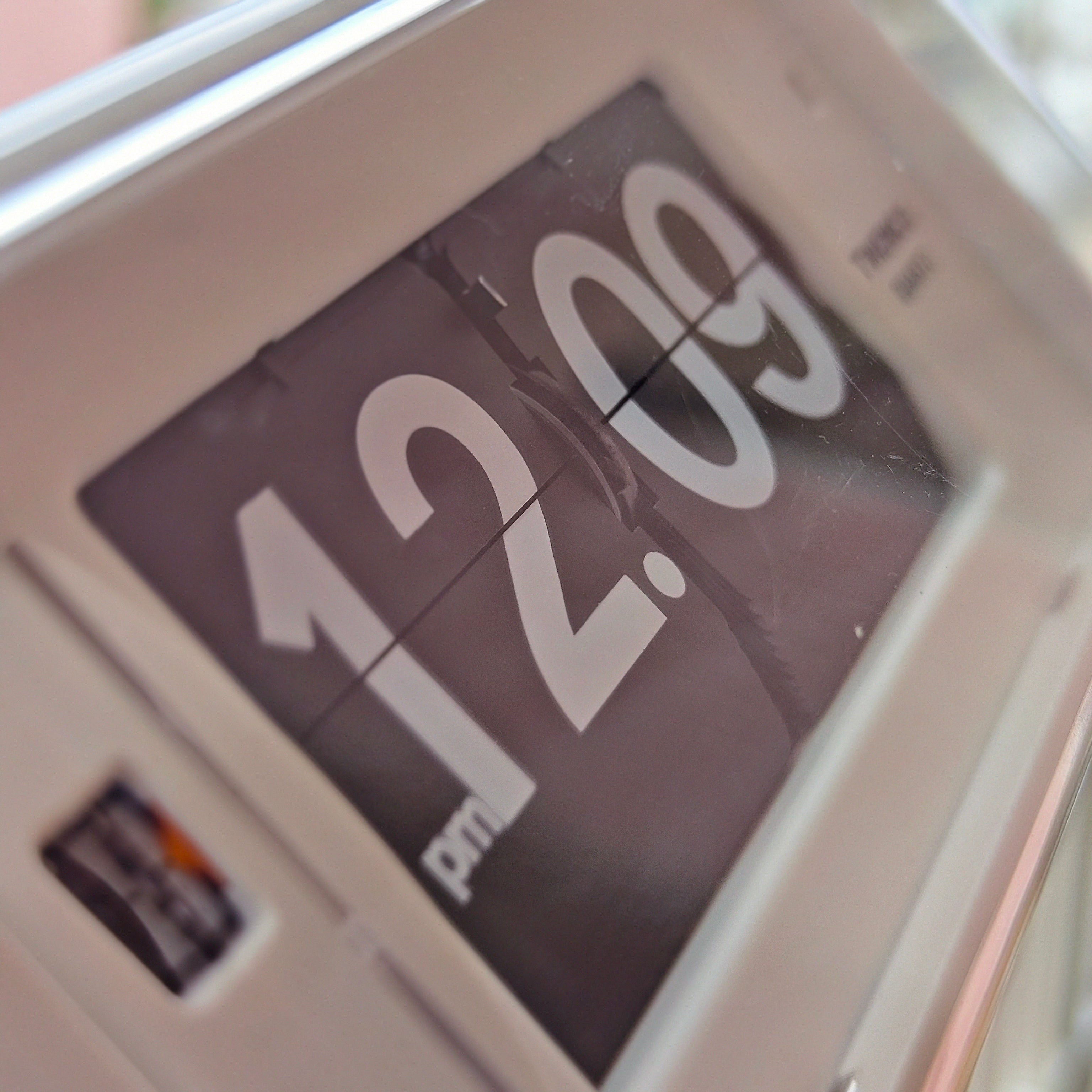
A mechanical flip clock and a digital flip clock can show exactly the same time, yet they create very different experiences—and different cost structures. One changes the display by physically releasing printed cards. The other changes illuminated or liquid-crystal segments electronically—and may imitate the flip with an animation. Our guide to why flip clocks can be expensive explains how the physical mechanism, materials and production scale shape the price.
The short answer is simple: choose a mechanical flip clock if you value physical movement, tactile character and a display that behaves like an object. Choose a digital clock if you prioritise silent operation, extra functions, compact size or easy night-time visibility. Neither format is automatically more accurate; timekeeping quality depends more on the movement or electronic circuit than on how the time is displayed.
Mechanical flip clock vs digital flip clock at a glance
| Feature | Mechanical flip clock | Digital flip clock |
|---|---|---|
| Display | Printed cards or leaves move physically | LED, LCD or another electronic screen |
| Change of time | A motor and release mechanism advance the cards | Electronic segments or pixels change instantly or animate |
| Sound | Usually an audible click or flap movement | Usually silent unless an alert is enabled |
| Light | Usually reflective and readable with room light | May glow, use a backlight or rely on ambient light |
| Maintenance | Moving parts can collect dust or need adjustment | Few exposed moving parts; screen and electronics can still fail |
| Design effect | Three-dimensional, kinetic and visibly mechanical | Compact, precise and visually clean |
| Best for | Desks, shelves and statement interiors | Bedrooms, travel, alarms and information-rich displays |
What counts as a mechanical flip clock?
A mechanical flip clock has a physical display made from cards, leaves or flaps. Each card carries part or all of a numeral. As the mechanism advances, gravity and a controlled release let the next card fall into view. A split-flap display patent describes the underlying idea at a larger scale: multiple printed flaps are moved and positioned to present changing information.
“Mechanical” describes the display action, not necessarily the time base. Many modern flip clocks use a battery-powered quartz movement and a small motor to trigger the physical change. Older clocks may use mains-powered synchronous motors or other arrangements. In other words, a clock can keep time electronically while presenting it mechanically.
If you want a closer look at the gears, motor and card sequence, see our guide to how a mechanical flip clock works.
What is a digital flip clock?
A digital clock displays time as numerals rather than with hands. Most current designs use LED or LCD technology. Some show fixed seven-segment digits; others use a screen animation that makes each number appear to fold or flip.
That animation can look convincing, but nothing physical changes position. The screen redraws the image. The distinction matters when shopping because “flip clock” can refer either to a real moving-card mechanism or to a digital display using flip-style graphics.
Digital clocks can also combine the time with alarms, calendar information, brightness control and other functions without adding a separate physical card drum for every item.
How the two formats feel in everyday use
Physical movement versus screen change
The strongest difference is not the numeral style; it is the presence of motion. A real card has thickness, casts a small shadow and changes the face of the clock once every minute—or more often on models with seconds. The movement is brief but noticeable.
A digital display is flatter and more immediate. Its digits can update without a moving component, and a screen can show alarms, temperature, date or multiple time zones without adding separate card drums. That flexibility makes digital clocks practical when information density matters.
Sound and atmosphere
A mechanical flip clock normally makes some sound when a card releases. The volume and tone vary with the size, case, card material and mechanism, so a product should not be called silent unless its manufacturer specifically says so. In a living room or studio, the regular click may feel like part of the object’s character. On a bedside table, it may be distracting to a light sleeper.
Most digital displays change silently. The clock may still beep, buzz or use an alarm speaker, but the act of changing the minute does not require a flap to fall. For sound-sensitive bedrooms, a conventional digital clock or a truly silent analogue model is usually easier to evaluate.
Brightness and readability
Printed flip cards do not normally emit light. They depend on room light, like a book or wall sign, which makes them visually calm during the day but difficult to read in darkness. Contrast, numeral size and viewing angle matter more than brightness settings.
LED digits emit light and are easy to see at night, although an overly bright display can dominate a dark room. LCD clocks vary: some are reflective and need ambient light, while others use a backlight. If brightness or visual comfort is your main concern, our separate comparison of flip and digital clocks for eye comfort looks more closely at flicker, contrast and continuous illumination.
Accuracy: the display is not the timekeeper
It is tempting to assume that a digital display must be more accurate because it looks precise. That is not a reliable rule. The display tells you how the time is presented; the oscillator and regulating electronics determine how it is measured.
Many clocks in both categories use quartz. The NIST timekeeping FAQ explains how a frequency error in a quartz watch translates into daily time error. Temperature, component tolerance, ageing, battery condition and circuit design can all affect drift. A mechanical flip display adds another consideration: the cards must release at the intended moment. A clock can keep a sound internal time signal yet show a late minute if a card sticks. Our guide to flip-clock accuracy explains how to separate monthly drift, display lag and card faults.
For buyers, the practical questions are therefore: What movement does the model use? Does it include radio or network synchronisation? Is the display mechanism aligned correctly? And how easy is it to reset after a battery change or power interruption?
Power and placement
Battery-powered mechanical flip clocks can be placed without a visible cable, which is useful on shelves and desks. Their motors draw power intermittently to advance the cards, but runtime varies by movement, card load, battery chemistry and added features. Check the exact manufacturer specification instead of assuming a universal battery life.
Digital clocks range from small battery-powered LCD units to plug-in LED displays. A continuously illuminated screen generally needs a steadier energy supply than a non-illuminated display, but power use differs widely. USB power can be convenient on a desk; a cable may be undesirable on an open shelf.
Placement should follow the actual model rather than the category name. Compare the dimensions, mounting method, viewing angle, power source and cable route before deciding. Our room-by-room guide to choosing between a flip clock and a digital clock applies those checks to living rooms, desks, bedrooms and shared spaces.
Maintenance and longevity
A mechanical flip clock has moving parts and exposed gaps around the cards. Dust, bent cards, weak batteries, incorrect levelling or rough handling can interrupt the sequence. Routine care is usually simple: keep the display dry, remove loose dust gently, replace batteries as recommended and avoid forcing a card by hand. Internal lubrication or motor work should follow the maker’s instructions or be left to a qualified repairer.
A digital clock needs less mechanical attention, but it is not maintenance-free. Buttons can wear, battery contacts can corrode, LED segments can fail and LCD panels can lose contrast. A sealed electronic unit may be harder to repair than a simple mechanism even though it needs less day-to-day care.
If ownership effort matters, read the warranty and parts policy. Repairability depends on construction, component availability and manufacturer support—not simply on whether the display is mechanical or digital.
Design: object presence versus visual neutrality
A mechanical flip clock tends to occupy visual space. The cards, frame and moving edges give it depth, so it can work as kinetic décor as well as a timekeeper. Models such as the Nordic Retro Mechanical Flip Clock suit buyers who want the mechanism to remain visible rather than disappear into the room.
A digital clock can be more visually neutral. Thin screens, smaller cases and adjustable brightness make digital designs easier to integrate where the clock should provide information without becoming the focal point. A compact option such as the MUJI Minimal Digital Desk Clock represents that cleaner, screen-based approach.
For a broader look at physical flip formats, the Twemco flip clock collection includes table, wall and calendar models built around printed cards and physical movement.
Which one should you choose?
Choose a mechanical flip clock when you want:
- a real moving display rather than a screen animation;
- a tactile, retro or industrial design feature;
- ambient time that does not glow continuously;
- a clock whose small sound and motion are part of its appeal.
Choose a digital clock when you want:
- quiet minute changes;
- night-time visibility or adjustable brightness;
- alarms, temperature, date or other functions in a compact case;
- simple ownership with no exposed display cards.
If you like the look of flipping numerals but need a silent bedside clock, a digital flip animation may be the better compromise. If the movement itself is the reason you are buying the clock, confirm that the listing describes real cards, leaves or a split-flap mechanism. Product photos should show physical card edges or drums, not only a flip-style font.
There is no universal winner. A mechanical flip clock is an expressive object that happens to tell time; a digital clock is usually an efficient information device that can be styled to resemble one. The right choice depends on which of those roles matters more in your room. If you are weighing the experience against sound, space and price, see our guide to whether flip clocks are worth it.
Frequently Asked Questions
Is a mechanical flip clock fully mechanical?
Not necessarily. Many modern flip clocks use a quartz movement and an electric motor while retaining a physical card display. “Mechanical” often refers to the moving display rather than to a spring-driven timekeeping mechanism.
Are digital flip clocks silent?
The display change is normally silent because it happens electronically, but alarms, speakers, buttons or other functions may still make sound. Check the manufacturer’s sound claims if the clock is for a bedroom.
Which type is more accurate?
Neither display type is automatically more accurate. Accuracy depends on the oscillator, regulating circuit, synchronisation method and operating conditions. A physical flip mechanism must also release its cards at the correct moment.
How can I tell whether a flip clock uses real cards?
Look for terms such as physical flip cards, split-flap, drop-leaf or moving-card mechanism. Product images should reveal separate card edges, drums or axles. A listing that mentions an LCD, LED screen or animated flip effect is digital.