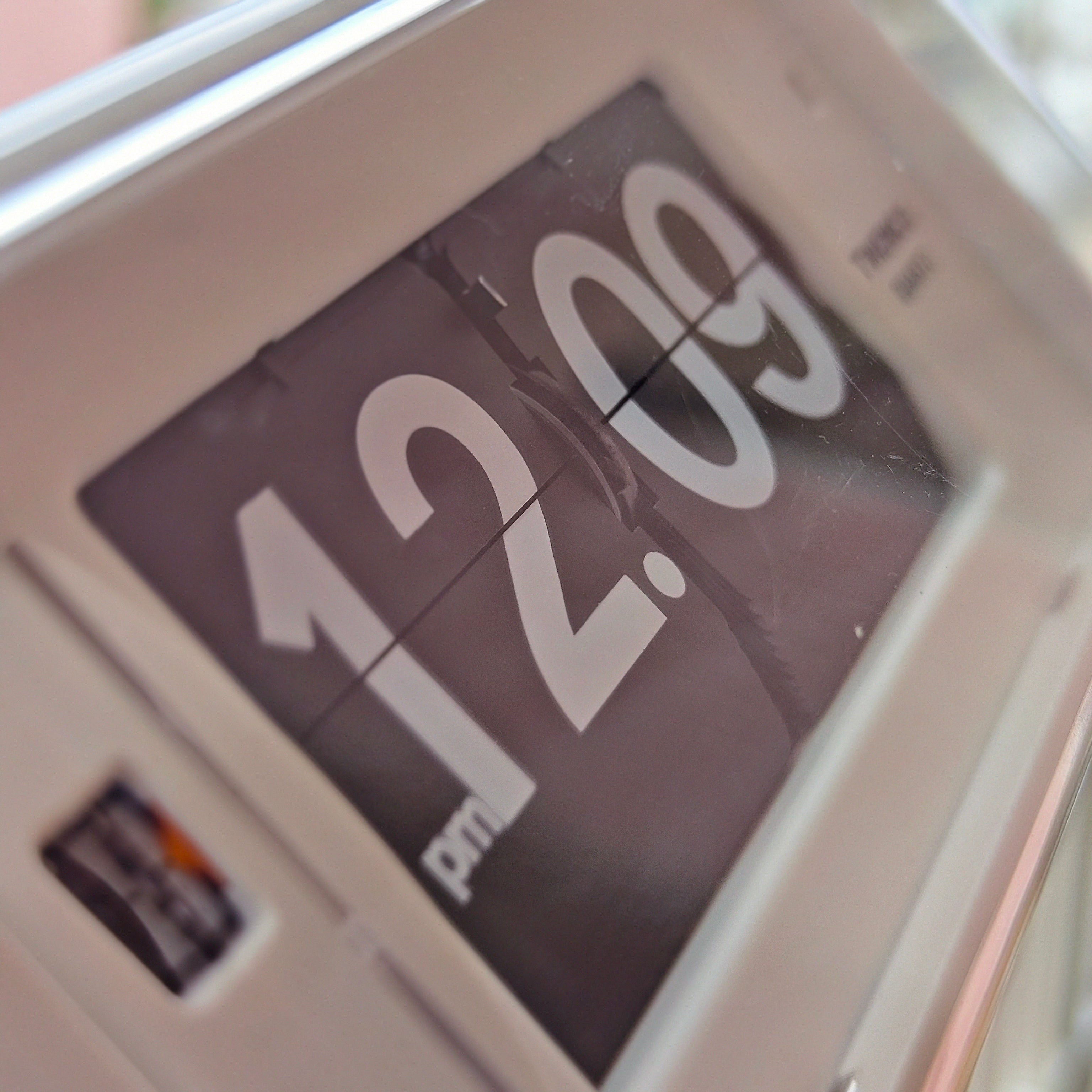
The right wall-clock size is not determined by room dimensions alone. A clock has to fit the usable section of wall, relate to nearby furniture and remain readable from the places where you will actually check the time.
A practical choice begins with measurements, not a label such as “small”, “large” or “oversized”. Record the available wall area, the width of any furniture below it and the main viewing distance. Then make a full-size paper template before you drill. That simple test tells you more than a styled product photograph.
Wall-clock size at a glance
The bands below are useful shopping shorthand, not universal design standards. For round clocks, use the diameter. For rectangular clocks, use the full case width and height.
| Approximate case width or diameter | Typical role | Where it often works | What to check |
|---|---|---|---|
| Under 30 cm / 12 in | Compact or secondary clock | Kitchen wall, home office, narrow return wall or small bedroom | Whether the numerals remain clear from the normal viewing position |
| 30–45 cm / 12–18 in | Medium visual anchor | Living room, dining area, office or wall above a modest console | Furniture proportion, wall margins and glare |
| Over 45 cm / 18 in | Large statement clock | Broad wall, open-plan room or long sight line | Weight, mounting method, case depth and visual competition |
A clock can fall into one band but behave like another. A simple, high-contrast face may read clearly without looking visually heavy. A calendar clock with several smaller fields may need closer viewing even when its case is large. Treat overall size, display size and visual weight as three separate questions.
Step 1: measure the usable wall, not the whole room
Start by defining the rectangle the clock can actually occupy. Exclude door swings, shelves, switches, mouldings, wall lights, curtains, a television and any area where a tall object on the furniture could block the display. Measure the remaining width and height.
Then stand in the room and identify the wall’s natural boundaries. A clock between two windows belongs to the section between them, not to the full width of the room. A clock above a sideboard belongs to the visual zone created by that sideboard. This prevents a mathematically fitting clock from feeling misplaced.
Wall shape matters too. A wide, low wall usually favours a horizontal clock or a composition that spreads laterally. A narrow vertical section can make a round clock or compact square model feel more settled. Architectural Digest’s hanging guide similarly recommends using wall shape as a guide and planning the layout with tape before making holes.
If you are still deciding whether the clock belongs on the wall at all, our guide to wall clocks versus desk clocks separates the placement decision from the sizing decision covered here.
Step 2: relate the clock to the furniture below it
When a clock sits above a sofa, console, desk or sideboard, that furniture is usually the more useful reference than the wall edge. Center the proposed clock over the furniture first, then judge how much empty space remains on each side.
Interior-styling guidance for artwork can provide a starting point. Pottery Barn’s wall-art guide suggests artwork spanning about two-thirds of the furniture width below it. A clock is not a framed print, so do not apply that ratio blindly: an open-frame clock, a deep flip clock and a visually dense calendar display carry different weight. Use the ratio to make your first paper template, then adjust by eye.
For example, a compact clock can look intentional above a narrow console when lamps or objects complete the composition. The same clock alone above a long sofa may look stranded. Conversely, an oversized clock above a light desk may dominate both the furniture and the person using it.
Leave practical clearance as well as visual breathing room. Furniture doors should open freely, table lamps should not cover the numerals and a seated person should not risk touching a low-mounted clock. If you plan to add framed art around it, judge the complete grouping as one composition rather than sizing every piece independently.
Step 3: size for the real viewing distance
Ask where the time must be legible from. A kitchen clock may be checked from a worktop a few steps away. A living-room clock may be read from a sofa across the room. An open-plan clock may need to work from both the dining table and the kitchen.
Do not assume that a larger case always provides larger readable information. Check numeral height, contrast, viewing angle and the amount of information displayed. A time-only clock can devote most of its face to hours and minutes. A day-date calendar clock divides the available area among more fields.
A useful home test is to reproduce the listed case outline at full size and add sample numerals close to the manufacturer’s stated dimensions. Tape it in position, then check it from every important seat and doorway in daylight and after dark. If the product does not publish numeral dimensions, zooming an online image is not reliable; ask the seller or choose a model whose readability you can assess confidently.
Our broader guide to the best living-room clocks compares display types, sound and placement once you know the approximate scale you need.
Step 4: choose a size that matches the room’s job
Living room
A living-room clock may be either a focal point or a quiet supporting object. A broad empty wall and a long sofa can support more visual presence, while a room already led by a television, fireplace or large artwork usually needs a calmer clock.
Medium sizes often work as flexible starting points because they can remain visible without automatically taking over the wall. The TWEMCO Classic Wall Flip Clock BQ-58, for example, has a rectangular 313 × 181 mm case. Its proportions are different from a 31 cm round clock, so compare the complete outline rather than one number.
For a deliberately large statement, the TWEMCO Jumbo Wall Flip Clock BQ-100 is listed at 476 × 280 mm. That added width, depth and weight make mounting and negative space part of the buying decision. Browse the TWEMCO flip-clock collection when you want to compare case formats without mixing in draft or legacy pages.
Dining area
A dining-room clock is often viewed while people are seated, so test the height and angle from the chairs rather than centering it mechanically on the full wall. A clock above a sideboard should relate to the sideboard and any lamps or serving objects placed there.
If the clock shares a wall with art, decide which piece leads. Two equally strong focal points can make the wall feel unsettled. A simple clock can join a gallery arrangement, while a detailed flip or calendar display usually benefits from a clearer field around it.
Kitchen
Kitchen walls are frequently interrupted by cabinets, appliances and doorways. A compact clock can work better than a nominally “correct” large diameter if it fits a clean sight line. Keep it away from heat, steam and splashes unless the manufacturer specifically approves the location.
Prioritise quick legibility over statement scale. Check the clock from the preparation area and the room entrance. Also confirm that battery replacement or time-setting controls remain accessible after mounting.
Bedroom or home office
In a bedroom or office, the clock may be seen at a shorter distance. A compact model can be sufficient, especially on a secondary wall. Consider sound and night-time visibility alongside dimensions; a large clock that is easy to read can still be wrong for the room if its operation is distracting.
For an information-rich compact option, the Small Fartech Wall Clock AD-650 is listed as a 9.5-inch square case with time and calendar fields. Its smaller day and date information still needs to be tested from the intended viewing position. The Fartech collection provides related wall-clock formats for comparison.
Step 5: test the full-size outline before buying
- Mark the product’s exact width and height on paper or joined sheets of newspaper.
- Cut out the outline, including any unusually deep or projecting part that affects placement.
- Tape it temporarily to the wall with a removable method suitable for the finish.
- View it from the main seat, doorway and any connected room where the time should be readable.
- Place the usual lamps, books or decorative objects on the furniture below it.
- Leave the template up for a day and check it under different lighting conditions.
This catches common mistakes before purchase: a clock that is technically too small for the sight line, a case that crowds a wall light, or a statement piece that competes with the television. It also helps two people agree on scale without relying on vague terms such as “medium”.
Mounting requirements can change the answer
Before committing to a large clock, record its weight and inspect the mounting hardware specified by the manufacturer. Wall construction matters: plasterboard, masonry, tile and timber do not use the same fixings. Architectural Digest recommends choosing hardware according to both wall type and object weight.
Follow the exact product manual rather than a generic online tutorial. NeXtime maintains a library of wall-clock and model-specific manuals, including instructions for its Big Flip models. If the correct fixing method is unclear, use a qualified installer.
Depth also matters for flip clocks. The case projects farther from the wall than a flat dial, so check the side view, traffic path and viewing angle. Make sure moving cards remain unobstructed and that the battery compartment can be reached without repeatedly removing an awkwardly mounted clock.
A practical decision rule
Choose the smallest wall clock that is comfortably readable from the required positions and still feels proportionate to its wall or furniture anchor. Move up in size when the sight line is long, the wall is broad or the clock is intended to be the room’s focal point. Move down when another object already leads the room, the usable wall is narrow or you view the clock close up.
Do not buy from the room photo alone. Use listed dimensions, a full-size template and the actual viewing positions. Once those three agree, the clock is far more likely to look as though it belongs.
After choosing the size, our guide to styling a room around a statement wall clock can help with colour, lighting and surrounding objects.
Frequently Asked Questions
Is a 30 cm wall clock big enough for a living room?
It can be, especially in a compact room or above modest furniture. Test a 30 cm paper template and sample numerals from the main seating position; viewing distance and contrast matter more than the diameter alone.
Should a wall clock be centred on the wall or the furniture?
When furniture clearly anchors the composition, centre the clock in relation to that furniture first. On an otherwise empty standalone wall, use the usable wall section and the main sight line as your guides.
How high should a wall clock be mounted?
Start near the eye level of the people who will read it, then adjust for furniture, seated viewing and the clock’s display angle. Use the manufacturer’s mounting instructions and test the outline before making holes.
Does a bigger clock always make the time easier to read?
No. Numeral height, contrast, glare, viewing angle and display complexity all affect readability. Compare the actual information area, not only the outside case dimensions.