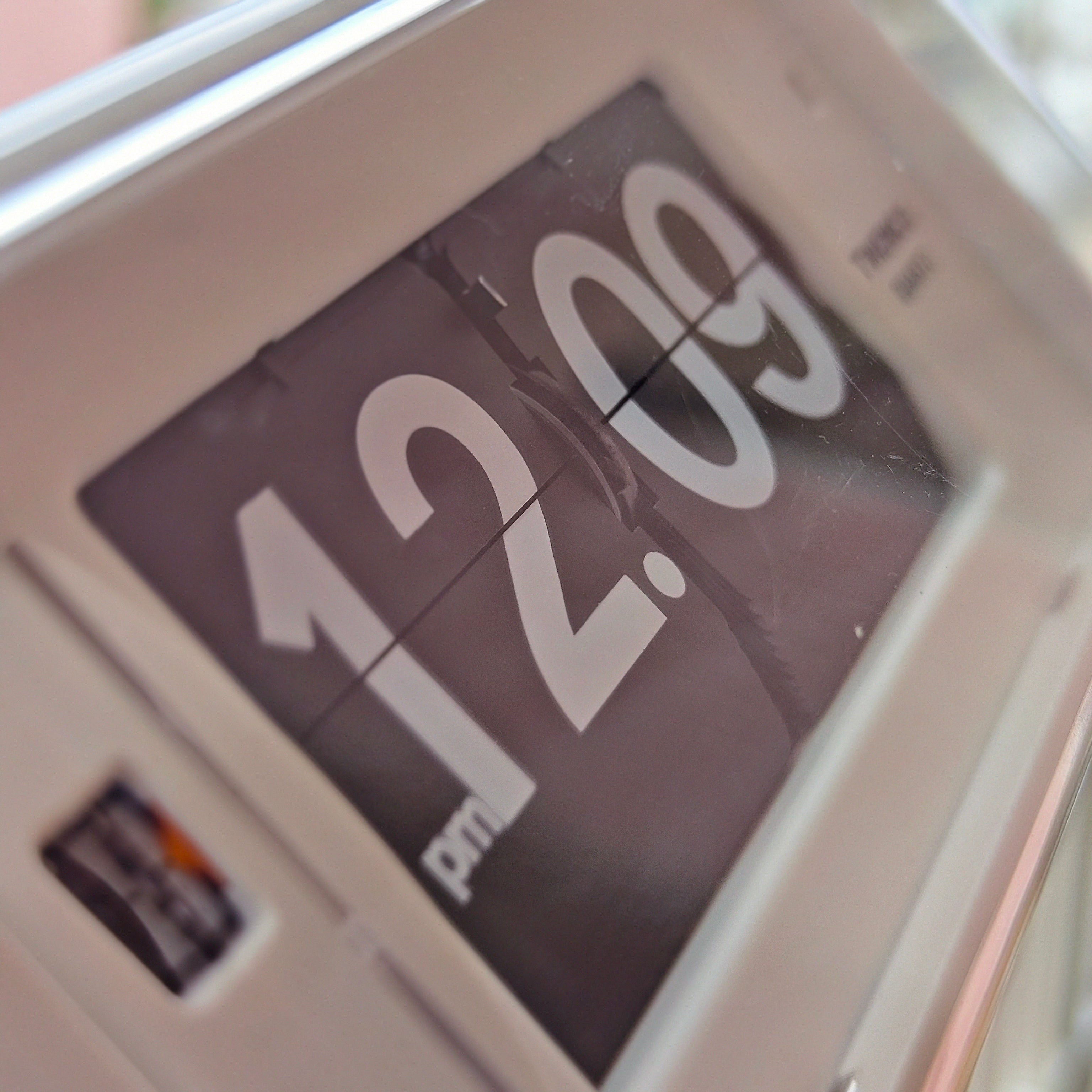
Some people collect mechanical watches. Others restore vintage cameras or typewriters. Then there are those who become fascinated by flip clocks.
At first glance, a flip clock seems simple. It tells the time using numbered cards instead of hands or an LCD screen. But spend a few minutes watching one operate, and it's easy to understand why horology enthusiasts and retro technology fans are drawn to it. A flip clock isn't just a way to display time—it's a beautifully engineered machine that puts its mechanics on display. Understanding how a mechanical flip clock actually works only makes the experience more fascinating.
For many collectors, that's exactly the appeal.
More Than Timekeeping
Today's clocks are designed to disappear into the background. Smartphones, smartwatches, and digital displays show the time instantly, but they rarely make you think about how they work.
A mechanical flip clock does the opposite.
Every minute is announced with a satisfying flip as one card falls and another takes its place. Rather than hiding the passage of time, it celebrates it. Watching the mechanism work becomes part of the experience.
This visible movement creates a connection that modern electronics often lack. Instead of software animations, you're seeing gears, springs, motors, and precisely engineered components working together in real time.
The Joy of Mechanical Engineering
Horology has always been about appreciating clever engineering.
Luxury mechanical watches attract collectors because hundreds of tiny components work together with remarkable precision. While a flip clock is mechanically simpler than a Swiss watch, it delivers a similar sense of satisfaction.
Every rotating drum, every gear, and every flipping card has a purpose—much like the essential parts of a clock found in traditional timepieces. Nothing feels unnecessary.
The movement isn't hidden behind a touchscreen—it becomes part of the product's personality.
That's why many enthusiasts enjoy leaving their flip clock where it's easy to see throughout the day rather than hiding it in the corner of a room.
A Different Kind of Precision
Unlike purely digital displays that silently update pixels on a screen, an electromechanical flip clock performs a physical action every minute.
The timing has to be accurate enough for the flip cards to change cleanly without hesitation. Each card must align perfectly before the next one appears.
When everything works together correctly, the result feels incredibly satisfying.
It's not about speed—it's about precision you can actually watch.
The Appeal of Retro Technology
There's growing appreciation for technology that people can understand.
Vinyl records reveal their grooves.
Mechanical keyboards let you feel every keystroke.
Film cameras expose the entire photographic process.
Flip clocks belong to this same category.
Instead of hiding behind software and processors, their operation is tangible. You can often hear the mechanism engage before watching the next number appear.
For retro technology fans, that transparency makes the experience far more engaging than another digital display.
An Object That Invites Interaction
Most modern electronics discourage interaction.
Once they're set up, they quietly do their job.
A flip clock is different.
People naturally find themselves waiting for the next minute just to watch the cards flip.
Guests often walk over for a closer look.
Collectors enjoy demonstrating the mechanism because it's something that can be experienced, not simply explained.
In that sense, a flip clock behaves almost like a kinetic sculpture. Even when it's sitting still, you know another movement is only moments away.
Built for Decades, Not Upgrade Cycles
Retro technology enthusiasts often value products that last.
Mechanical watches are serviced instead of replaced.
Vintage cameras remain usable after generations.
Quality flip clocks share the same philosophy.
Many well-maintained mechanical flip clocks continue operating for decades, becoming permanent fixtures in homes, offices, and studios.
Rather than becoming obsolete every few years, they simply continue marking time exactly as they always have.
That longevity gives them a character that disposable electronics rarely develop.
The Satisfaction of Analog Living
As daily life becomes increasingly digital, many people are embracing the analog aesthetic by intentionally adding analog objects back into their environments.
A notebook replaces a note-taking app.
A record player replaces streaming for an evening.
A mechanical clock replaces another glowing screen.
Flip clocks fit naturally into this movement because they encourage people to notice time instead of constantly checking notifications.
The familiar flip every minute is subtle, calming, and reassuring—a gentle reminder that time is moving forward one moment at a time.
Final Thoughts
To some people, a flip clock is simply a clock.
To horology enthusiasts, it's a fascinating mechanical system.
To retro technology fans, it's a reminder that great design doesn't need software updates, touchscreens, or cloud connectivity to remain enjoyable.
Every flip is a tiny mechanical performance—one that's been captivating collectors for generations.
If you appreciate thoughtful engineering, timeless industrial design, and products built to be admired as much as used, a flip clock isn't just another way to tell time.
It might just become your favourite grown-up toy.