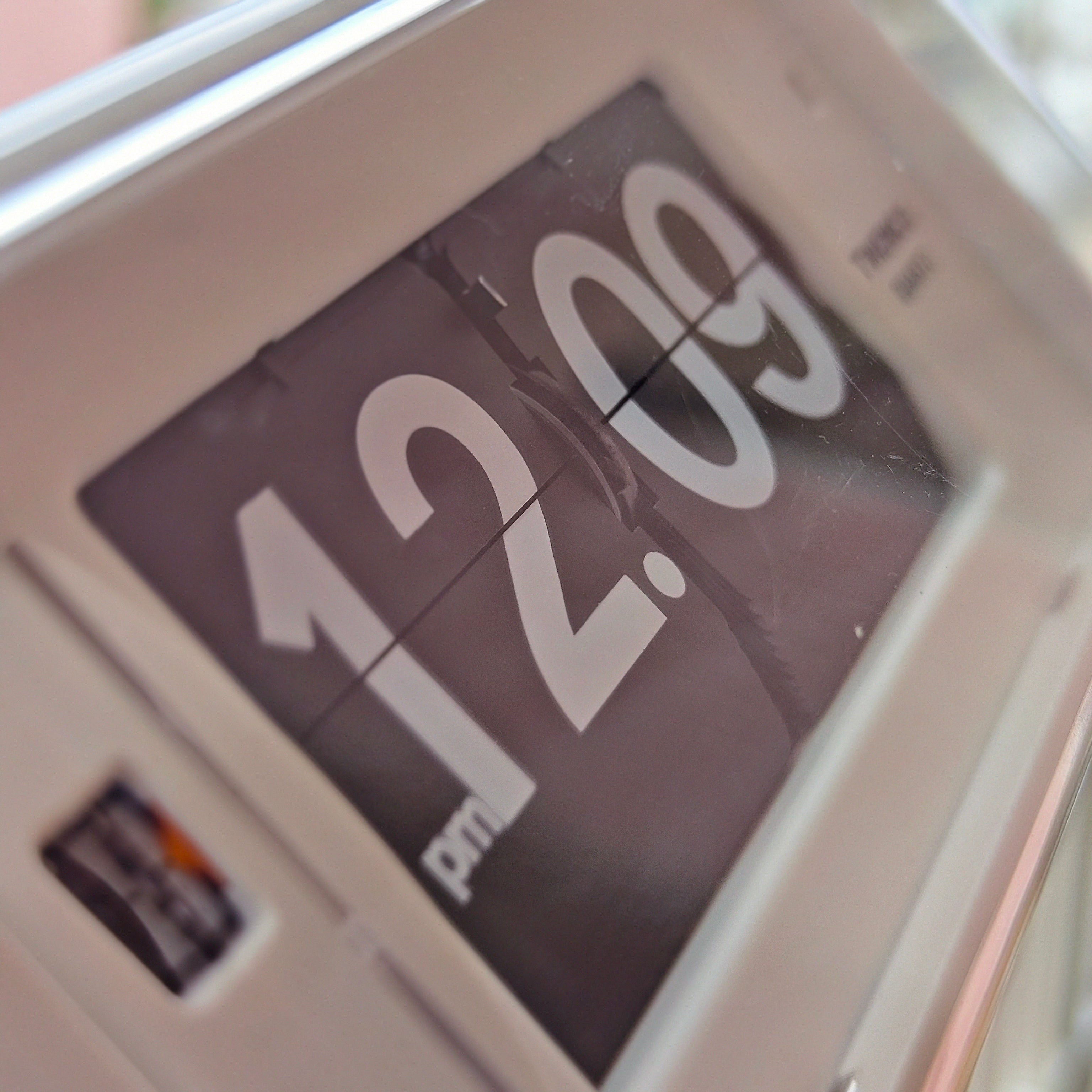
A flip clock can last for many years, and a well-made example may remain usable for decades. But there is no honest universal lifespan figure. A clock’s service life depends on its movement, display mechanism, materials, environment, battery care, repairability and how gently it is handled.
It is also important to separate the life of the clock from the life of its battery. A manufacturer may quote one, two or three years of operation from a set of batteries; that is a maintenance interval, not the point at which the clock itself should fail. The same clock may go through many battery cycles during its working life.
What “lifespan” means for a flip clock
Owners often use lifespan to describe several different things:
- Battery runtime: how long the clock operates before its battery needs replacing. Our guide to flip-clock battery consumption explains what affects that interval and how it varies between models.
- Timekeeping life: how long the quartz movement or synchronous motor continues to keep time.
- Display life: how long the cards, drum, gears and release mechanism continue to advance correctly.
- Useful life: how long the complete clock remains reliable, presentable and worth maintaining.
These do not necessarily end together. A clock can keep accurate time while a card sticks, or its display can flip cleanly while the movement gradually drifts. Our guide to flip-clock accuracy and display timing explains how to tell those problems apart.
So, how long should a flip clock last?
For a new clock, the best evidence is the exact model’s specification, warranty and parts support—not a broad claim about all flip clocks. Manufacturers usually publish power, accuracy and operating-condition data, but rarely guarantee a fixed total service life.
TWEMCO’s official specifications illustrate the distinction. The company lists an “operation” period of two years for the BQ-38, one year for the BQ-50 and three years for the QT-35. Those figures refer to operation on the specified alkaline batteries. They do not say that the clocks last only one to three years.
In practice, a sound modern flip clock should be viewed as a maintainable object rather than a sealed product with an expiry date. Some will need only batteries and basic care for a long time. Others may eventually need a motor, movement, gear or display repair. Vintage clocks introduce another variable: they may already have worked for several decades, but their future life depends heavily on their condition, previous repairs and the availability of suitable parts.
If you are researching one manufacturer specifically, our article on why some TWEMCO clocks last for decades looks at that brand’s construction and ownership experience. It should not be treated as a guarantee for every model or every clock.
The parts most likely to limit service life
The power source and battery contacts
A depleted battery is routine maintenance. Leakage and corrosion are different: they can damage terminals, wiring and the movement itself. Energizer’s battery-care guidance recommends removing exhausted batteries promptly, replacing batteries with the same size and type, and keeping contact surfaces clean.
Use the battery chemistry and size specified by the maker. Do not mix old and new cells, and remove batteries if the clock will be stored for a long period. If you see swelling, leakage or corrosion, stop using the battery and follow local safety and disposal guidance rather than touching residue with bare hands.
The motor or quartz movement
The movement establishes the pace of time and provides or controls the energy used to advance the display. Age, electrical faults, dried contamination, worn bearings or damaged gears can eventually cause weak operation, erratic timing or a complete stop.
A movement failure is not always the end of the clock. Whether repair is sensible depends on part availability, labour cost and the value of the object. A modular modern movement may be replaceable; a rare vintage motor may require specialist repair or a carefully sourced donor part.
Gears, cams and release parts
The display relies on small components working in sequence. Wear, misalignment or contamination can increase resistance until the motor can no longer complete a flip. Warning signs include labouring sounds, repeated hesitation, missed minutes and a display that stops between positions.
Do not compensate by forcing the cards. Our explanation of how a mechanical flip clock works shows why one apparently simple movement depends on several linked parts.
The cards and their supports
Flip cards are light so that the mechanism can move them efficiently. That also makes them vulnerable to bending, cracking, abrasion and incorrect handling. Heat and direct sunlight can affect some plastics and printed surfaces over time, while impact during moving or shipping can dislodge cards or their supports.
The case and controls
A clock may still run after a cracked case, broken adjustment control or weakened wall mount makes normal use unsafe or inconvenient. This is part of useful life, even when the timekeeping mechanism is intact. Good mounting and careful time-setting matter as much as internal engineering.
What makes one flip clock last longer than another?
Build quality and mechanical margin
A rigid frame, correctly supported shafts, consistent card spacing and a motor with enough torque all reduce the chance that small changes become failures. Construction quality is difficult to judge from styling alone, so look for a clear manufacturer, model number, instructions, warranty and realistic after-sales support.
Operating environment
Heat, direct sunlight, high humidity, dust and unstable mounting can shorten a clock’s useful life. The Canadian Conservation Institute notes in its guidance on clocks and watches that dust can combine with oil to create sticky deposits, while unsuitable cleaning or lubrication can cause further damage.
For everyday use, keep the clock dry, stable and away from heaters, air-conditioning outlets and strong sun. Use the orientation specified by the maker: a wall model should be securely hung, and a tabletop model should sit level where it will not be knocked.
Correct maintenance
More maintenance is not always better. Adding household oil through an opening, spraying cleaner into the mechanism or dismantling cards without instructions can turn a minor fault into a difficult repair. The Institute of Conservation’s clock-care advice recommends appropriate professional guidance for cleaning, lubrication and replacement of worn parts, particularly where originality matters.
Routine owner care should stay conservative: external dusting with a soft, dry tool, timely battery replacement, gentle setting and observation for changes in sound or movement. For a step-by-step approach, see our flip-clock cleaning and maintenance guide.
Repairability and parts support
A durable product is not merely one that resists failure; it is one that can return to service. Screwed construction, identifiable components, replaceable movements and access to competent repair make a longer useful life more likely. By contrast, an inexpensive clock can become uneconomical to repair even when its fault is small.
How to extend the life of a flip clock
- Follow the exact model instructions. Use the specified battery, orientation and setting controls.
- Replace exhausted batteries promptly. Check the compartment during each change and never mix battery types or ages.
- Remove batteries for long storage. Store the clock dry, supported and protected from pressure on the cards or controls.
- Keep it away from extremes. Avoid direct sun, heat sources, damp rooms and places where grease or airborne dust can enter easily.
- Do not force a stuck display. Record what happened, check power and placement, then consult the instructions or a repairer.
- Clean lightly from the outside. Avoid liquid cleaner, compressed air and unapproved lubricants inside the mechanism.
- Respond to new symptoms early. A change in sound, incomplete flip or intermittent stop is easier to investigate before further wear occurs.
Long battery intervals can make a clock easy to forget, so it helps to record the installation date inside a household maintenance note. Our guide to battery efficiency in analog clocks explains why model-level runtime varies.
When should you repair, restore or replace it?
Repair is usually worth considering when the clock has sentimental value, good build quality, a recognised model, available parts or a fault that can be diagnosed without major cosmetic change. Restoration may be appropriate for a collectible vintage clock, but originality matters: replacing cards, motors or finishes can change historical and monetary value.
Replacement may be more rational when the mechanism is sealed and unsupported, structural parts are badly damaged, electrical safety is uncertain or repair would cost more than the clock is worth to its owner. A professional assessment is especially important for mains-powered vintage clocks.
When shopping for a clock intended to stay, compare published specifications and support rather than relying on a lifespan slogan. The TWEMCO BQ-38 calendar flip clock and TWEMCO QT-35, for example, publish different battery-operation figures despite sharing a manufacturer. The broader TWEMCO flip-clock collection makes those model differences easier to compare.
Frequently Asked Questions
Do flip clocks wear out from flipping every minute?
Moving parts do experience wear, but the flip action alone does not determine lifespan. Materials, alignment, contamination, motor condition and handling all matter. A clean, correctly powered mechanism can repeat its short movement for many years.
Is battery life the same as clock lifespan?
No. Battery life is the interval before the battery needs replacing. The clock itself may continue through many battery changes. Always check whether a manufacturer’s “operation” figure describes battery runtime or total product life.
Should I leave a flip clock running all the time?
Many home and office flip clocks are designed for continuous time display. Our guide to leaving a flip clock running all the time explains when continuous use is normal and when to switch it off. Follow the exact model instructions, maintain the battery and stop using the clock if it begins sticking, making unusual sounds or overheating.
Can an old flip clock be repaired?
Often, but it depends on the fault and available parts. Battery contacts, wiring, motors, gears and cards may be repairable or replaceable. Rare vintage models should be assessed by someone familiar with flip mechanisms before parts are altered.